Slow-Feed Bowls for a Miniature Schnauzer: When They Help
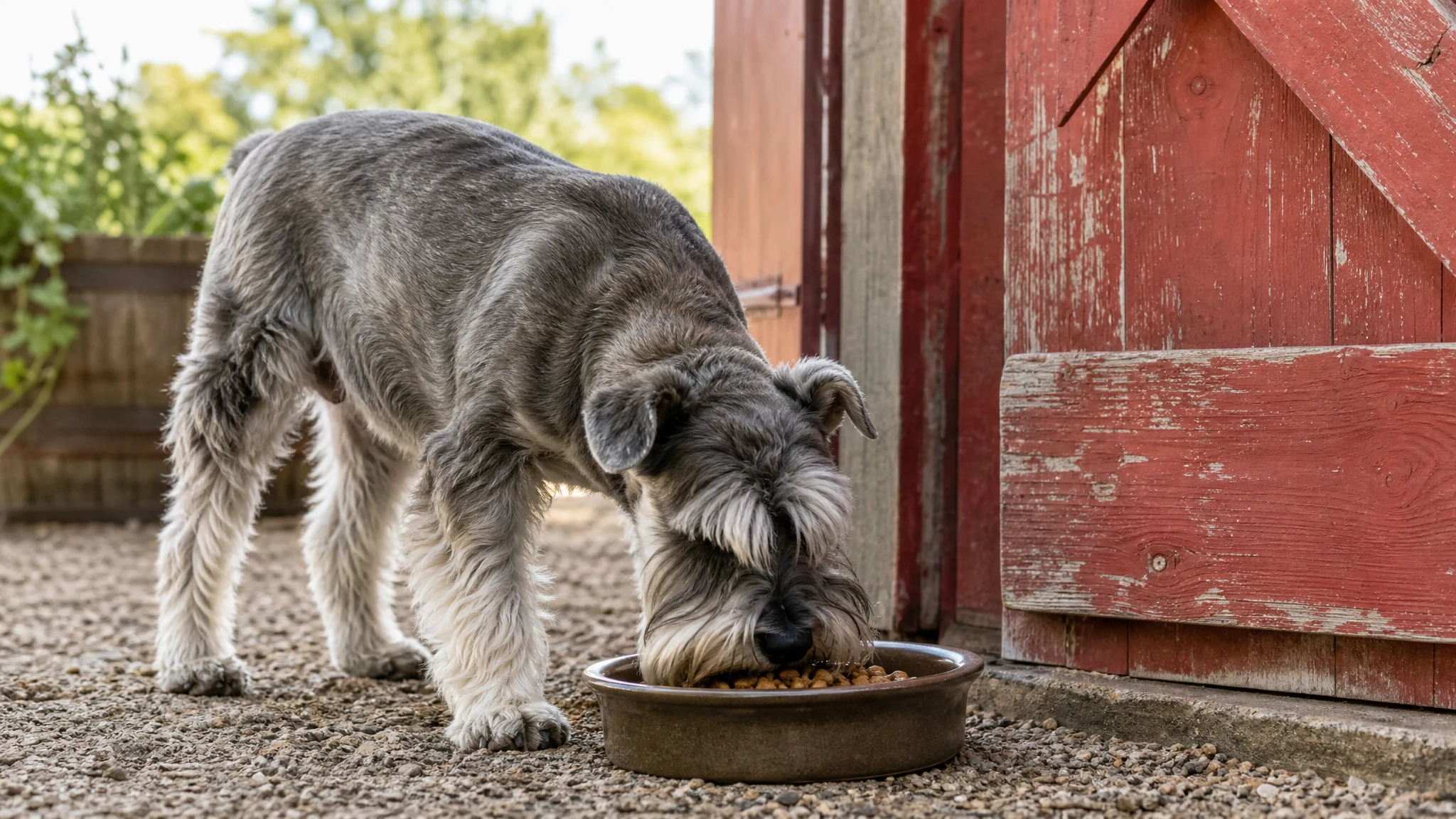
General nutrition information compiled from product labels and published sources, not veterinary advice. Your veterinarian is the right person to choose a diet for your dog, especially one with a health condition.
A slow-feed bowl has ridges, posts or mazes that make a dog work around the food. For some Miniature Schnauzers that turns a ten-second meal into a few minutes. For others it only adds frustration.
This guide explains when a slow-feed bowl is worth trying, how to set one up in a tidy dog feeding station, and how to judge whether it is working. We did not test any bowls. The advice here comes from published breed and label information, plus ordinary feeding common sense.
When a slow-feed bowl may help
A slow-feed bowl is a tool, not a treatment. It does not fix a medical problem, and no bowl should be expected to prevent or cure any condition. What it can do is change the pace of a meal.
It may be worth trying if your dog:
- Finishes a meal in under a minute and then looks for more.
- Gulps so fast that food comes back up soon after eating.
- Guards the bowl or acts frantic at mealtime.
- Gets bored with a plain bowl and benefits from a little mental work.
If your dog already eats at a relaxed pace, you probably do not need one. A plain bowl is fine.
Gulping and regurgitating can have medical causes. If it happens often, talk to your veterinarian before you assume the bowl is the answer.
Why the breed's health picture matters here
Science for Animal Welfare (formerly UFAW) describes the Miniature Schnauzer as predisposed to pancreatitis and to idiopathic hyperlipidaemia, meaning high triglycerides. It says hyperlipidaemia is seen most often in middle-aged and older dogs and tends to worsen with age.
These are predispositions, not diagnoses. They are a reason to keep meals steady and predictable and to be cautious with extras. A slow-feed bowl is one way to do that, but it does not change what is in the food. Whether your dog needs a lower-fat diet is a decision for your veterinarian.
The same applies to urinary health. A study indexed in PubMed Central describes the breed as having a high risk for calcium oxalate urinary stones. Diet and water intake questions belong with your vet, not with a bowl.
What you will need
- A slow-feed bowl sized for a small dog. Hill's Pet Nutrition lists adult Miniature Schnauzers at 10 to 18 lbs, with males about 14 inches tall and females about 13 inches at the withers. A bowl built for a large dog will be too deep and wide.
- A non-slip mat or a base that keeps the bowl from sliding.
- Your dog's regular food, measured with a proper measuring cup or a kitchen scale.
- A shallow dish or flat plate, for the comparison step below.
- A small notebook or phone note for tracking meals and body condition.
- A quiet corner for the dog feeding station.
Step-by-step: setting up and introducing a slow-feed bowl
1. Choose the right bowl design
Pick a bowl with shallow, rounded ridges rather than deep, narrow channels. A small dog's muzzle can struggle to reach food in tight grooves, and that is how a helpful tool turns into a source of stress.
Choose food-safe, dishwasher-safe material that is easy to scrub. Grooves hold residue, especially with wet or fresh food.
2. Build a calm dog feeding station
Set the bowl on the non-slip mat in a low-traffic spot. Keep it away from the front door, other pets and the kitchen's busiest path. Put a water bowl nearby so fresh water is always available.
A consistent location helps your dog understand that this spot means meal time. Wipe the mat and area after each meal.
3. Confirm the amount before you pour
A slow-feed bowl changes how fast your dog eats, not how much your dog should eat. Start with the feeding guide on your food's label and treat it as a starting point.
Brands publish different guides. For example, Royal Canin's Miniature Schnauzer Adult page lists 1 cup (86 g) daily for an 11 lb dog with low activity. VICTOR's Hi-Pro Plus Small Breed Adult chart runs from 1/2 cup for a 5 lb dog to 2 1/4 cups for a 30 lb dog, using a standard 8 oz cup. Hill's says to adjust amounts as needed to maintain optimal weight and to ask your veterinarian if you are unsure.
Those numbers come from different foods with different calories, so do not mix and match them. Use the guide for the food you actually feed. For a full breakdown by age, see our Miniature Schnauzer feeding chart by age.
If your dog has a health condition, confirm the amount and the schedule with your veterinarian before you change anything.
4. Let your dog sniff the empty bowl first
Put the clean, empty bowl on the mat and let your dog investigate. Drop a few kibbles in and let your dog find them. Praise calmly and give no pressure.
If your dog backs away, wait a day and try again. Forcing a nervous dog's face into a new object teaches the wrong lesson.
5. Start with an easy version
For the first few meals, put only part of the portion in the bowl, spread across the ridges. Keep the rest ready in a regular dish. If your dog gets frustrated or stops eating, offer the remainder in the plain dish right away.
Rewarding the effort with a calm "good" and then letting your dog finish keeps mealtime pleasant. This follows the reward-based approach recommended by the American Veterinary Society of Animal Behavior (AVSAB).
6. Move to the full portion
Over several days, put the whole meal in the slow-feed bowl. Watch your dog's posture and face. A relaxed dog works steadily. A dog who paws at the bowl, whines or flips it may need a simpler design.
7. Track results for two weeks
Write down how long meals take, whether any food comes back up, and your dog's body condition. Run your hands along the ribs. You should be able to feel them under a light covering, and your dog should have a visible waist from above. If you are unsure, ask your veterinarian to show you how to score body condition.
8. Clean it after every meal
Wash the bowl with hot soapy water or run it through the dishwasher if the maker says it is safe. A small brush helps with ridges. Check for cracks or chew marks, which can hide bacteria or become a hazard.
Tips for a smoother setup
- Match the bowl to the food. Small kibble can slip through wide gaps, while large pieces may not fit narrow ones. Hill's lists its Adult 7+ Small & Mini dry food as nibble-size kibble. Kibble size is not given for many other foods, so check with the brand if it matters to you.
- Use it for wet or fresh food carefully. Soft food can pack into grooves and is harder to clean. A flat lick mat or plain dish may be easier for those meals.
- Keep treats in the daily count. Pancreatitis is a known concern in the breed, so rich extras are worth discussing with your vet.
- Feed on a schedule. Dividing the day's amount into regular meals helps keep your dog from arriving at the bowl desperately hungry. Your vet can suggest a schedule if your dog has a health condition.
- Do not skip supervision at first. Watch the first several meals so you can step in if your dog chokes, gags or gives up.
Common mistakes to avoid
- Buying a bowl that is too hard. Frustration can make a fast eater faster once the food is accessible.
- Using it as a diet tool by shrinking the meal. If your dog needs to lose weight, your vet should set the target and the amount.
- Treating gulping as only a speed problem. Frequent vomiting, retching or a swollen belly needs a veterinary visit.
- Feeding several dogs side by side without separation. Competition can make eating faster, not slower.
- Letting the bowl go uncleaned. Residue builds up in ridges faster than in a plain dish.
- Leaving the bowl as the only option. If a puzzle bowl is stressful, drop it. It is optional.
What results to expect
Many dogs eat more slowly in a slow-feed bowl, and some owners find that mealtime feels calmer. That is a reasonable thing to hope for, but results vary from dog to dog, and no bowl is a guarantee of anything.
A slow-feed bowl may help with pace and mental engagement. It should not be expected to prevent or treat pancreatitis, urinary stones, bloat, allergies or any other condition. What goes in the bowl matters far more than the bowl. A veterinarian decides what diet suits an individual dog, including whether a prescription diet is appropriate.
If after two weeks your dog is eating at the same speed, avoiding meals or seems distressed, go back to the plain dish. That is a sensible outcome, not a failure.
How we approached this guide
We compared published breed information and product label data. We did not run feeding trials, taste tests or bowl tests. For any product, check the brand's own page for current label details.
Sources
- Hill's Pet Nutrition: Miniature Schnauzer breed page
- Science for Animal Welfare: Miniature Schnauzer pancreatitis and hyperlipidaemia
- PubMed Central: Urogenital microbiome in Miniature Schnauzers with and without calcium oxalate urolithiasis
- Royal Canin: Miniature Schnauzer Adult Dry Dog Food
- VICTOR: Hi-Pro Plus Small Breed Adult
- Hill's Science Diet: Adult 7+ Small & Mini Chicken & Brown Rice Recipe