How Much to Feed a Miniature Schnauzer: Feeding Chart by Age and Weight
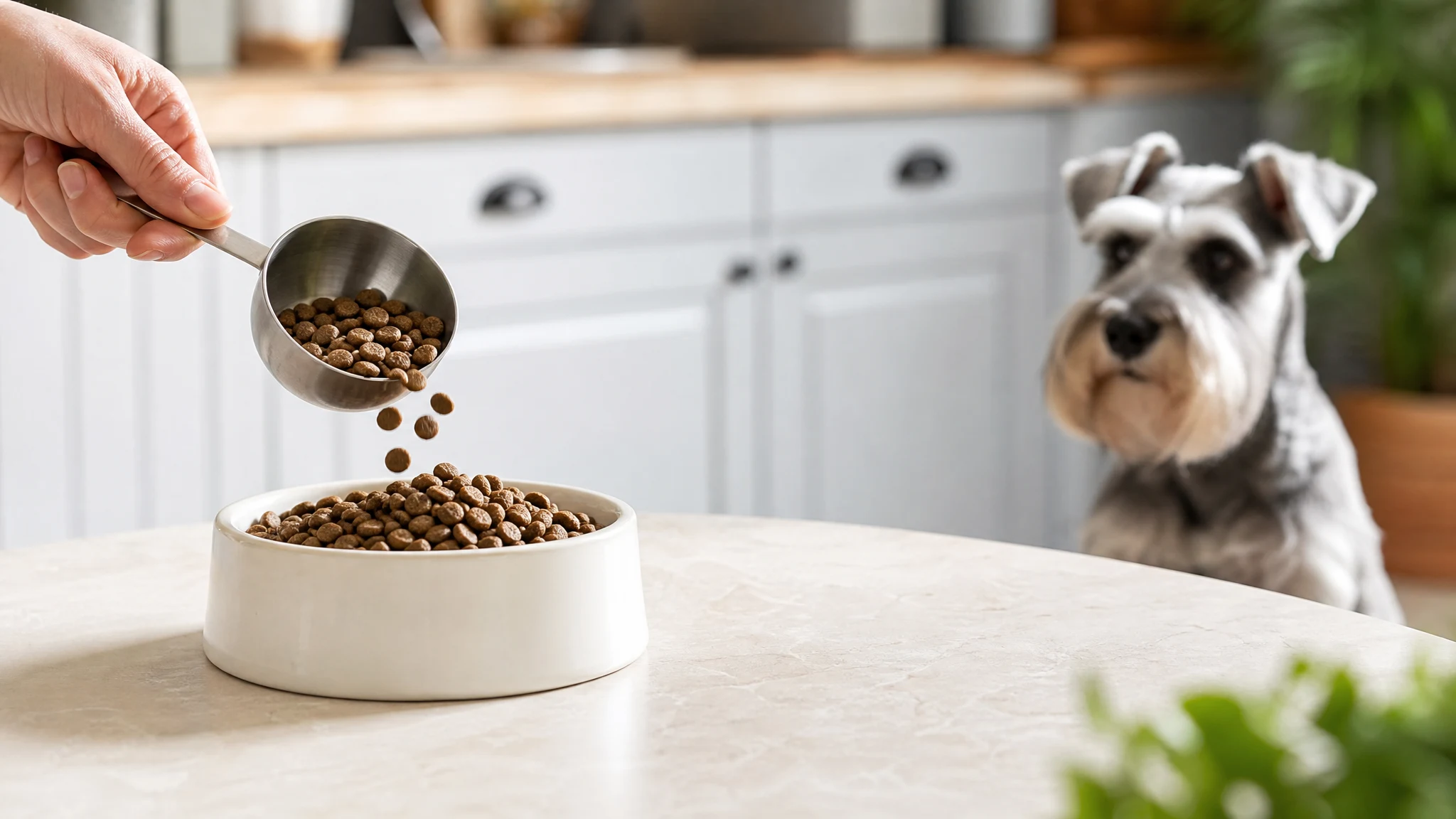
General nutrition information compiled from product labels and published sources, not veterinary advice. Your veterinarian is the right person to choose a diet for your dog, especially one with a health condition.
Every bag and tray has a feeding guide, and no two guides agree. That is the first thing to know when you ask how much to feed a Miniature Schnauzer. The answer depends on the food's calories, your dog's weight and activity, and how your dog looks and feels.
This guide walks you through a method. You will read the label, find a starting amount, check your dog's body condition, and adjust. The Miniature Schnauzer feeding chart below shows what several real labels say. It is a comparison of label data. We did not run feeding trials or taste tests.
What size is a Miniature Schnauzer?
The Hill's Pet Nutrition breed page lists adult males at 11 to 18 lbs and adult females at 10 to 15 lbs. Height at the withers is about 14 inches for males and 13 inches for females. The same page gives a life expectancy of 12 to 14 years.
That puts the breed in the small category. No source labels the category directly, so this comes from the published weight range. It also means the large-breed puppy rules do not apply. The AAFCO cutoff for large size dogs is 70 lb or more as an adult, and this breed is far below it.
Materials you need
- The food you plan to feed, with its bag, can, tray or pouch label in hand.
- A standard measuring cup, or better, a kitchen scale that reads in grams.
- A scale for your dog. A home bathroom scale works if you weigh yourself, then yourself holding the dog, and subtract.
- A notebook or phone note to record weight, amounts and body condition.
- Your veterinarian's contact details for the questions this page cannot answer.
Step 1: Weigh your dog and note the adult range
Start with a real number. Compare it to the 10 to 18 lb range the Hill's Pet Nutrition breed page gives for adults. A dog outside that range is not automatically a problem, but it is worth a conversation with your veterinarian.
For a puppy, write down the age and your best estimate of adult size. Some puppy labels, like Royal Canin's Miniature Schnauzer Puppy, base their table on expected adult weight.
Step 2: Find the calories on the label
Cups are not a fair unit across foods. A cup of one food can hold far more energy than a cup of another. Look for the kcal per cup, per tray or per kilogram on the brand's page.
Here are the figures from the brand pages for foods that suit a small dog:
- Royal Canin Miniature Schnauzer Adult: 309 kcal ME per cup, as fed (calculated).
- Royal Canin Miniature Schnauzer Puppy: 341 kcal ME per cup, as fed (calculated).
- Hill's Science Diet Adult Small & Mini Chicken & Brown Rice: 357 kcal per cup.
- Hill's Science Diet Adult 7+ Small & Mini Chicken & Brown Rice: 359 kcal per cup.
- Hill's Science Diet Puppy Small & Mini Chicken & Brown Rice: 418 kcal per cup.
- VICTOR Hi-Pro Plus Small Breed Adult: 360 kcal per cup.
- Freshpet Small Dog Bite Size Chicken Recipe: 267 kcal per cup.
- Nom Nom Chicken Cuisine: 244 kcal per cup (calculated, with 1 cup equal to 219 g).
The spread is large. Nom Nom's figure is about two thirds of the Hill's puppy figure. A cup of one food is not a cup of another.
Step 3: Read the feeding guide as a starting point
Each brand's guide is built around its own food. Use only the guide printed for the food in your bowl. Do not carry a cup amount from one food to another.
Miniature Schnauzer feeding chart: what the labels say
The table shows the examples the brand pages give. Where a page gives no amount for a weight, the cell says so. The calorie column is simple multiplication of the label's cups by the label's kcal per cup, so treat it as a rough comparison.
| Food (brand page) | Label feeding example | Label kcal per cup | Rough kcal for that example |
|---|---|---|---|
| Royal Canin Miniature Schnauzer Adult | 11 lb (5 kg), low activity: 1 cup (86 g) per day | 309 | About 309 |
| Nom Nom Chicken Cuisine | 10 lb adult: 1 cup (218 g) per day | 244 | About 244 |
| Freshpet Small Dog Bite Size Chicken | 5 to 10 lb: 1/2 to 1 cup per day | 267 | About 134 to 267 |
| VICTOR Hi-Pro Plus Small Breed Adult | 5 lb: 1/2 cup per day. The chart runs to 2 1/4 cups for 30 lb | 360 | About 180 at 5 lb |
| Hill's Science Diet Adult Small & Mini (dry) | No amount on the page text we relied on. It says to adjust to maintain optimal weight and to ask your veterinarian if unsure | 357 | Not applicable |
| Hill's Science Diet Adult Small & Mini Savory Stew (wet) | Chart runs from 1 1/2 trays for a 2 lb dog to 10 trays for a 30 lb dog (3.5 oz trays) | Per tray: page lists 81 kcal per "can" | Check the brand page |
Two things stand out. First, the Royal Canin and Nom Nom examples are for nearly the same size of dog, yet they differ by about 65 kcal. That is the effect of the food, not a sign that either label is wrong. Second, the Freshpet range is wide on purpose. It gives you room to adjust.
The Hill's Science Diet Adult 7+ and VICTOR puppy pages also publish their own feeding guides. For exact numbers at your dog's weight, open the brand's page and read the full chart.
Puppies
A Miniature Schnauzer puppy can eat a growth food or an all life stages food. Check the AAFCO statement. A food that says "except for growth of large size dogs" is not meant for large-breed puppies, which is not a concern for this breed's expected adult size. A food that says "including growth of large size dogs" also covers puppies of this size.
Royal Canin's Miniature Schnauzer Puppy page gives a daily table by age (2 to 9 months) and expected adult weight (8.8 lb, 13 lb and 18 lb). It says to move to adult food after 10 months. Its Small Puppy page shows the amounts as an image that links to a feeding calculator. The Hill's Science Diet Puppy Small & Mini page has a growth table by weight and age range.
The facts we could confirm do not say at what age a Miniature Schnauzer counts as an adult. Royal Canin's own breed formulas switch at 10 months. Ask your veterinarian when to change, and how many meals a day suit your puppy.
Step 4: Measure the food accurately
A scoop is not a cup. Level a standard measuring cup, or weigh the portion in grams if the label gives grams. Royal Canin and Nom Nom both list grams next to cups. On a dog this small, a heaping scoop can add up to a real difference in calories.
For wet food, count trays or cans exactly as the label does. If you mix dry and wet food, ask your veterinarian how to split the daily amount so you do not feed the full portion of both.
Step 5: Score your dog's body condition
The label cannot see your dog. Body condition scoring is how you check whether the amount is right. It is a hands-on check, and your veterinarian can show you how on the first visit.
- Feel the ribs. Run your hands along the sides of the chest. You should feel the ribs under a thin layer of padding, without pressing hard. If you have to dig, the dog may be carrying extra weight. If the ribs stand out sharply, the dog may be too lean.
- Look from above. A healthy dog usually shows a visible waist behind the ribs. A straight or bulging outline can point to extra weight.
- Look from the side. The belly should tuck up from the chest toward the hind legs, not hang level or sag.
- Check the coat effect. A Miniature Schnauzer's wiry coat can hide the body shape. Use your hands, not just your eyes.
Repeat this every two weeks and write the result down. If your dog scores heavy, trim the portion in small steps. If your dog scores lean, raise it in small steps. Ask your veterinarian how big a step is safe for your dog.
Step 6: Adjust for activity and life stage
The Royal Canin adult table is organized by dog weight and activity level, and its example is for a low-activity dog. That fits what most owners see. A dog who walks briskly every day may need more than a dog who mostly naps. Dogs differ even at the same weight.
Age matters too. Hill's makes a separate Adult 7+ Small & Mini food with its own calorie figure and feeding chart. An older dog who moves less may need a different amount than the same dog at age three. Spayed or neutered status, medical conditions and medications can also change needs. Those are questions for your veterinarian.
Step 7: Talk to your veterinarian about breed health factors
Some conditions in this breed relate to diet. These are predispositions, not diagnoses, and no food is described here as preventing or treating any of them.
- Science for Animal Welfare says the breed is predisposed to pancreatitis and to idiopathic hyperlipidaemia (high triglycerides). It says hyperlipidaemia is seen most often in middle-aged and older dogs and tends to worsen with age.
- A study in PubMed Central describes the breed as having a high risk for calcium oxalate urinary stones.
If your dog has had either problem, or if your veterinarian is watching blood fat levels or urine, the feeding plan may differ from any label. Fat content, treats and table scraps all become part of that conversation. A veterinarian decides what suits an individual dog. Prescription diets are something only a veterinarian prescribes.
On grain-free and other diets, the FDA has an ongoing page about canine dilated cardiomyopathy (DCM). Its latest update was December 23, 2022. The FDA said it does not plan more public updates until there is meaningful new scientific information. The page does not establish a cause, and adverse event reports alone do not show causation. If you are weighing a diet change, ask your veterinarian.
Tips for staying on track
- Weigh your dog at the same time of day, on the same scale, and record it.
- Change one thing at a time. If you switch foods and amounts together, you will not know which change caused what you see.
- Switch foods gradually, and ask your veterinarian how long to take.
- Count treats and chews. On a 10 to 18 lb dog, a few extras are a bigger share of the day than they look.
- Keep one person in charge of the bowl, or use a shared note, so the dog is not fed twice.
Common mistakes to avoid
- Copying the cup amount from another food. As the table shows, cups are not comparable across brands.
- Treating the label as a rule. It is a starting point written for an average dog.
- Using the wrong life stage. A puppy food at puppy calories can be too rich for a settled adult. Check the AAFCO statement for the stage you are feeding.
- Judging by looks alone. The wiry coat can hide extra weight. Use your hands.
- Cutting food sharply. If your dog needs to lose weight, ask your veterinarian for a plan.
- Ignoring changes. Sudden appetite changes, vomiting, belly pain or thirst changes are reasons to call your veterinarian, not to adjust the cup.
What to expect
If you measure carefully and re-check every couple of weeks, many owners find they settle on a steady amount within a month or two. Your dog's weight and body condition may then stay stable. Results vary, and a change in the dog's health, age or activity can mean starting the process again.
Weight and body condition are better signs than any chart. If the numbers drift, bring your notes to your veterinarian. Written weights and amounts make that visit more useful.
Bottom line
How much a Miniature Schnauzer should eat is not one number. It starts with the label for the specific food, adjusts to your dog's body condition and activity, and is confirmed by your veterinarian. Label guides are starting points. A veterinarian sets the amount for an individual dog.
Sources
- Hill's Pet Nutrition: Miniature Schnauzer breed page
- Royal Canin: Miniature Schnauzer Adult
- Royal Canin: Miniature Schnauzer Puppy
- Royal Canin: Small Puppy
- Hill's Science Diet: Adult Small & Mini
- Hill's Science Diet: Adult 7+ Small & Mini
- Hill's Science Diet: Puppy Small & Mini
- Hill's Science Diet: Adult Small & Mini Savory Stew
- VICTOR: Hi-Pro Plus Small Breed Adult
- Freshpet: Small Dog Bite Size Chicken Recipe
- Nom Nom: Chicken Cuisine
- Science for Animal Welfare: Miniature Schnauzer pancreatitis and hyperlipidaemia
- PubMed Central: Urogenital microbiome in Miniature Schnauzers with and without calcium oxalate urolithiasis
- FDA CVM: Investigation into potential link between certain diets and canine dilated cardiomyopathy