Miniature Schnauzer Feeding Chart: How Much to Feed by Weight
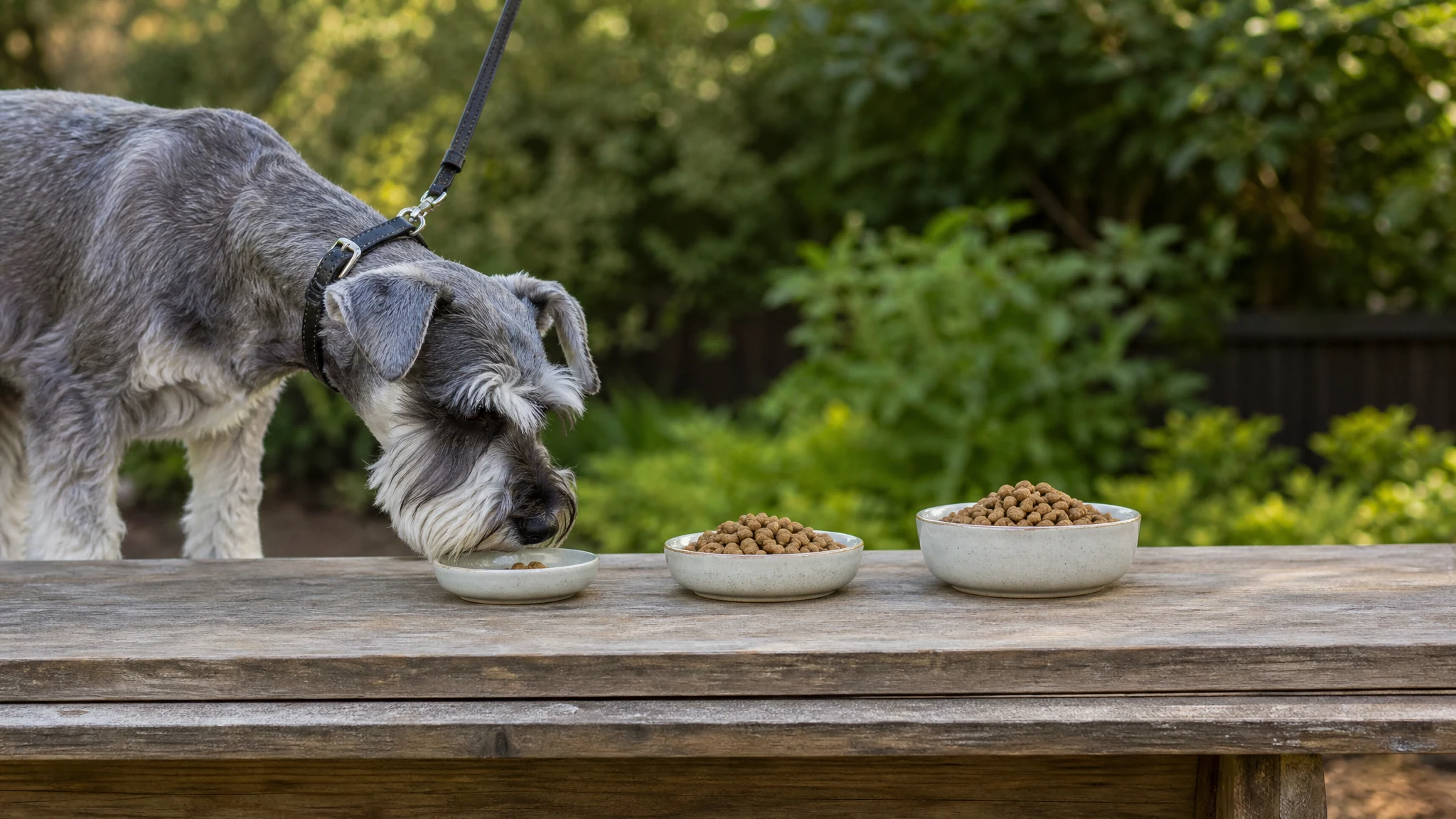
General nutrition information compiled from product labels and published sources, not veterinary advice. Your veterinarian is the right person to choose a diet for your dog, especially one with a health condition.
There is no single number that fits every Miniature Schnauzer. Hill's Pet Nutrition lists adult males at 11 to 18 lbs and females at 10 to 15 lbs. That is a wide range, and activity, age and body condition change the answer further.
This guide shows how to build your own Miniature Schnauzer feeding chart from the label on your dog's food. It then shows how to adjust that chart over time. The amounts below are label starting points, not prescriptions.
One note on method: we compared label data published by the brands. We did not run feeding trials or taste tests.
What You Need
- Your dog's current weight, taken the same way each time (a kitchen scale for a small dog, or a vet visit scale).
- The bag, can or tray of food you actually feed, with its feeding guide and calorie statement.
- A standard 8 oz measuring cup, or better, a kitchen scale that reads in grams.
- A notebook or phone note to log weight and portions.
- Your veterinarian's contact details, since some steps below call for their input.
Step 1: Confirm Your Dog's Weight and Life Stage
Weigh your dog before you read any chart. Feeding guides are built on body weight, so a guess of "about 15 lbs" can shift the portion noticeably in a dog this small.
Then note the life stage. Royal Canin's Miniature Schnauzer formulas split at 10 months: the puppy formula covers 8 weeks to 10 months, and the adult formula covers purebred Miniature Schnauzers 10 months and older. Hill's has a separate Adult 7+ small and mini recipe for seniors. Other brands may draw the lines elsewhere, so read the label.
If you have a puppy, our Miniature Schnauzer feeding chart by age covers how portions change as a puppy grows.
Step 2: Check the Nutritional Adequacy Statement
Find the AAFCO statement on the package. It tells you whether the food is meant for growth, maintenance or all life stages. A feeding chart only makes sense if the food is complete and balanced for your dog's stage.
Some foods say "except for growth of large size dogs (70 lb or more as an adult)." That wording matters for giant-breed puppies. A Miniature Schnauzer's adult weight is well under 70 lbs, so that wording does not rule a food out for this breed.
Step 3: Find the Calories Per Cup
Calories per cup vary a lot between foods. A cup of one food is not a cup of another. The label figures below show the spread:
| Food (brand label) | Form | Label calories |
|---|---|---|
| Royal Canin Miniature Schnauzer Adult | Dry | 309 kcal ME per cup, as fed (calculated) |
| Hill's Science Diet Adult Small & Mini Chicken & Brown Rice | Dry | 357 kcal per cup |
| Hill's Science Diet Adult 7+ Small & Mini Chicken & Brown Rice | Dry | 359 kcal per cup |
| VICTOR Hi-Pro Plus Small Breed Adult | Dry | 360 kcal per cup |
| Freshpet Small Dog Bite Size Chicken Recipe | Fresh | 267 kcal per cup |
| Nom Nom Chicken Cuisine | Fresh | 244 kcal per cup (calculated) |
Swapping between these foods cup for cup would change your dog's daily calories. That is why the chart must come from the label of the exact food you buy.
Step 4: Read the Label's Feeding Guide by Weight
Next, find your dog's weight on the manufacturer's chart. Here is what a few brands publish on their own pages:
| Brand and food | What the label feeding guide says |
|---|---|
| Royal Canin Miniature Schnauzer Adult | Daily table by weight and activity level. An 11 lb (5 kg) low activity dog gets 1 cup (86 g). |
| VICTOR Hi-Pro Plus Small Breed Adult | Daily amounts from 1/2 cup at 5 lbs up to 2 1/4 cups at 30 lbs, using a standard 8 oz cup. |
| Freshpet Small Dog Bite Size Chicken | Dogs of 5 to 10 lbs get 1/2 to 1 cup per day. |
| Nom Nom Chicken Cuisine | A 10 lb adult gets 1 cup (218 g) per day. Amounts vary by age, weight and activity. |
| Hill's Science Diet Adult Small & Mini Savory Stew (wet) | Chart runs from 1 1/2 trays for a 2 lb dog to 10 trays for a 30 lb dog. |
Hill's dry adult recipes tell owners to adjust amounts as needed to maintain optimal weight, and to ask a veterinarian if unsure. Some brands, such as Royal Canin's Small Puppy and JustFoodForDogs, show their charts as images or calculators, so use the brand's own page for those figures.
Notice that two foods can list different cups for the same weight. That is expected, because their calories per cup differ.
Step 5: Pick a Starting Amount and Measure It
Use the label's number for your dog's weight as the first week's portion. If your dog sits between two rows, many owners start with the lower row and watch the results. Confirm that choice with your vet if your dog has any health condition.
Measure every meal. Scooping with a coffee mug or a cup that is not a true 8 oz measure is a common source of drift. Weighing in grams is more consistent, especially for kibble, because kibble packs differently from scoop to scoop.
The labels above do not tell you how many meals to use. Many owners split the daily amount into two portions, but confirm the schedule that suits your dog with your vet. Whatever you choose, keep the daily total at the chart amount, not per meal.
Step 6: Count Treats and Extras
Treats, chews, training rewards and table scraps all add calories, and in a dog of 10 to 18 lbs a few extras go a long way. Keep them small and count them against the daily total. Reduce meal portions slightly on days with a lot of training rewards.
Do not add supplements to the bowl on your own. If your vet recommends one, follow their instructions for amounts rather than anything found online.
Step 7: Check Body Condition and Adjust
Every two to four weeks, weigh your dog and look at their shape. You should be able to feel the ribs under a thin layer of tissue, and see a waist from above. If you cannot feel ribs, or the waist has disappeared, ask your vet whether to trim portions. If ribs are very prominent, ask whether to increase them.
Make changes in small steps and log them. The chart is a starting estimate, and your dog's metabolism, age and activity decide where it ends up.
Breed Points to Raise With Your Vet
Some health tendencies in this breed involve diet, so portions and fat content are worth discussing. Science for Animal Welfare (formerly UFAW) says Miniature Schnauzers are predisposed to pancreatitis and to idiopathic hyperlipidaemia, meaning high triglycerides. It notes the latter is seen most often in middle-aged and older dogs and tends to worsen with age.
A paper in PubMed Central also describes a high risk of calcium oxalate urinary stones in the breed. These are predispositions, not diagnoses, and no food on a shelf prevents or treats them. Only your veterinarian can decide whether your dog needs a particular diet, and prescription diets are something a vet prescribes.
If your dog has pancreatitis, high triglycerides, urinary stones or any other condition, confirm every amount with your vet before using a label chart.
Tips and Common Mistakes
- Using one brand's chart for another brand's food. Calories per cup differ, as the table above shows.
- Estimating weight. A pound or two is a large share of a small dog's body.
- Free feeding. Leaving a full bowl out makes the daily total hard to track.
- Ignoring treats. They count toward the daily calories.
- Changing foods abruptly. Mix the new food in gradually over several days, and call your vet if stools stay loose.
- Treating the chart as fixed. Neutering, aging and activity changes all shift needs. Recheck every few months.
- Judging by marketing. Words like "natural" or "premium" are not nutrition data. Compare the AAFCO statement, ingredients and calories.
What to Expect
If the portion is a good fit, you may see a steady weight, a visible waist and normal energy over the following weeks. Stools may be consistent too. Results depend on the individual dog, and none of this is a guarantee.
If your dog gains or loses weight, seems hungry all the time, or has vomiting, loose stools or a drop in appetite, stop adjusting on your own and call your veterinarian.
About the FDA's investigation into diets and canine dilated cardiomyopathy: its last public update was December 23, 2022. The FDA said it does not intend to release further public updates until there is meaningful new scientific information. The agency's page states that adverse event reports alone do not show causation. If you are weighing grain-free or boutique diets, ask your vet and check the FDA page for anything newer.
Quick Recap
- Weigh your dog and note the life stage.
- Check the AAFCO statement on the food.
- Find calories per cup.
- Read the brand's feeding guide for your dog's weight.
- Start with that amount, and measure it.
- Count treats.
- Check body condition every few weeks and adjust with your vet.
Sources
- Hill's Pet Nutrition: Miniature Schnauzer breed page
- Royal Canin: Miniature Schnauzer Adult
- VICTOR: Hi-Pro Plus Small Breed Adult
- Freshpet: Small Dog Bite Size Chicken Recipe
- Nom Nom: Chicken Cuisine
- Hill's Science Diet: Adult Small & Mini dry
- Hill's Science Diet: Adult Small & Mini Savory Stew
- Science for Animal Welfare: Miniature Schnauzer pancreatitis and hyperlipidaemia
- PubMed Central: Urogenital microbiome in Miniature Schnauzers with and without calcium oxalate urolithiasis
- FDA CVM: Investigation into Potential Link between Certain Diets and Canine Dilated Cardiomyopathy