Feeding Stations for Miniature Schnauzers: What to Look for in a Bowl Setup
General nutrition information compiled from product labels and published sources, not veterinary advice. Your veterinarian is the right person to choose a diet for your dog, especially one with a health condition.
A dog feeding station is simply the spot where your dog eats and drinks: the bowls, the mat or tray under them, and the place you put them. It sounds minor. But for a small, sturdy breed that can be a quick eater, the setup shapes how tidy mealtimes are and how easily you can measure what goes in the bowl.
This guide walks through building a simple, practical dog feeding station for a Miniature Schnauzer, step by step. It also covers what to skip, because pet stores sell plenty of gear that adds cost without adding much.
A note on method: we did not buy, use or test any bowls or feeders. The advice below comes from the published size of the breed and from the feeding information printed on brand pages. We compared label data. We did not run feeding trials or taste tests.
Why the Miniature Schnauzer's size matters for bowl choice
Hill's Pet Nutrition lists adult Miniature Schnauzers at 11 to 18 pounds for males and 10 to 15 pounds for females. Height at the withers (the top of the shoulders) is about 14 inches for males and 13 inches for females. That is a small dog with a fairly sturdy frame.
Those numbers drive three choices: how wide the bowl is, how high it sits, and how much food it needs to hold. A bowl made for a large dog is awkward for a dog this size. A tiny toy-breed dish may be too small for the wiry beard, which tends to dunk into water and food.
Materials and items you will need
- One food bowl in stainless steel or ceramic, sized for a small dog.
- One water bowl that is heavy or weighted, so it is hard to tip.
- A non-slip mat or tray with a raised edge to catch drips.
- A kitchen scale that reads in grams or ounces, or a standard dry measuring cup.
- A tall, lidded container for storing the food in its original bag, if you like.
- A towel or washable cloth for wiping the beard after meals.
You do not need a smart feeder, a heated bowl or a themed set. Plain and washable is the goal.
Step 1: Pick the bowl material
Stainless steel and ceramic are the usual choices. Both are easy to wash and do not hold odors the way scratched plastic can. Choose whichever you will actually clean every day.
Check the underside of any ceramic bowl for chips or cracks. Small cracks are hard to clean and can scratch a dog's mouth. Replace a bowl that is damaged.
Common mistake: buying a bowl for looks and ignoring cleaning. If the bowl has a narrow seam or a decorative groove, food film collects there. A smooth interior is simpler to keep clean.
Step 2: Match the bowl shape to the face and beard
Miniature Schnauzers have a long muzzle and a bearded face. A wide, fairly shallow bowl lets the dog reach food without pressing the beard against a steep wall. A very deep, narrow bowl can make a small dog stretch and push food into a corner.
Look for a bowl with a flat or gently sloped base. That keeps kibble from piling up where the dog cannot reach it.
Step 3: Decide on bowl height
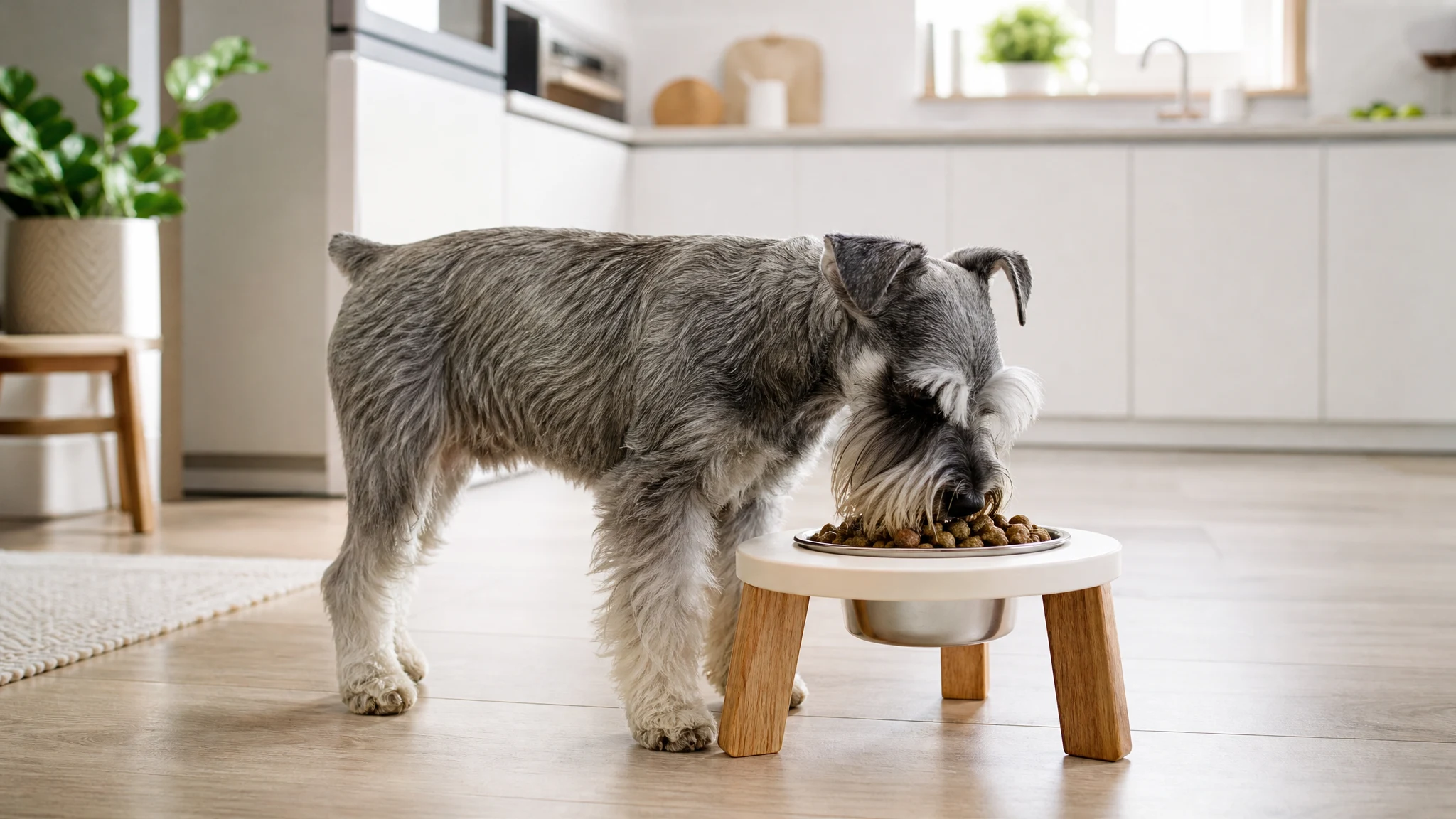
Many owners wonder about raised feeders. The practical rule is simple: the dog should be able to eat with a relaxed neck and without hunching or stretching. For a dog about 13 to 14 inches at the shoulder, a floor-level bowl is usually comfortable, and a modest stand may suit some dogs.
Be careful with claims you may read online about raised bowls and health. We did not find a source in our research that settles whether raised bowls help or harm a Miniature Schnauzer. If your dog has had stomach or digestive trouble, ask your veterinarian which height suits that individual dog before buying a stand.
Step 4: Set up the water bowl as part of the station
Put fresh water next to the food bowl and keep it filled. Wash it daily. A heavier bowl stays put when an enthusiastic dog bumps it.
Miniature Schnauzers are listed in published research as having a high risk for calcium oxalate urinary stones, according to a study in PubMed Central on the urogenital microbiome in the breed. Water and diet choices for a dog with a stone history are a conversation for your veterinarian. A clean, always-available water bowl is a sensible baseline, and your vet decides anything beyond that.
Step 5: Choose the spot
Pick a quiet corner with a washable floor, away from the main walkway. A dog that is jostled or startled while eating may gulp. Keep the station away from carpet, since spills are far easier to clean on tile or vinyl.
If you have more than one pet, feed them in separate spots or at least separate mats. This makes it easy to see who ate what, which matters when you are tracking portions.
Step 6: Build measuring into the station
This is the part that matters most. A bowl does not tell you how much food is in it. Measuring does.
Different foods pack different calories into a cup. The brand pages list these label figures:
| Food (dry) | Calories per cup on the label |
|---|---|
| Royal Canin Miniature Schnauzer Adult | 309 kcal ME per cup, as fed (calculated) |
| Hill's Science Diet Adult Small & Mini Chicken & Brown Rice | 357 kcal per cup |
| VICTOR Hi-Pro Plus Small Breed Adult | 360 kcal per cup |
So a level cup of one food is not the same as a level cup of another. If you switch brands, do not assume your old scoop still applies. Read the new label.
Weighing is more consistent than scooping, because a cup of kibble can vary with how tightly it is packed. Royal Canin's page, for example, lists a feeding amount in both cups and grams (1 cup, or 86 g, for an 11 lb dog with low activity). Placing the empty bowl on a scale and zeroing it is a quick habit.
Step 7: Start from the label guide, then adjust
Treat the feeding chart on the bag or brand page as a starting point. Amounts on a label are based on weight and, for some brands, activity level or age.
- Royal Canin's adult Miniature Schnauzer page has a daily feeding table by dog weight and activity level. Its example is 1 cup (86 g) for an 11 lb, low-activity dog.
- VICTOR's small breed adult chart runs from 1/2 cup a day for a 5 lb dog to 2 1/4 cups for a 30 lb dog, using a standard 8 oz cup.
- Hill's Science Diet small and mini adult page says to adjust amounts as needed to maintain optimal weight, and to ask your veterinarian if you are unsure.
For a deeper look at portions by life stage, see our guide to how much to feed a Miniature Schnauzer by age.
Weigh your dog every few weeks, check the body shape, and adjust the portion slowly. If your dog has a health condition, confirm amounts with your veterinarian before changing anything. That includes dogs with a history of pancreatitis, high blood fats or urinary stones.
Step 8: Think about the breed's diet-related health tendencies
Science for Animal Welfare (formerly UFAW) notes that Miniature Schnauzers are predisposed to pancreatitis and to idiopathic hyperlipidaemia, meaning high triglycerides. It says the high-fat blood problem is seen most often in middle-aged and older dogs and tends to worsen with age.
These are predispositions, not diagnoses. No bowl, feeder or food prevents or treats them. What a feeding station can do is make your routine steady: the same measured amount, the same place, no unmeasured extras. If your dog has a diagnosis, a veterinarian decides the diet. Prescription diets are only something a veterinarian prescribes.
Step 9: Set a cleaning routine
- Pick up the food bowl when the meal is done.
- Wash both bowls with hot, soapy water every day.
- Wipe the mat and the floor around it.
- Wipe the beard and muzzle with a damp cloth.
- Let everything dry before the next meal.
If you feed fresh or wet food, wash the bowl right away, since leftovers dry hard and stick. Follow the brand's own storage and serving directions for opened packages.
Tips and common mistakes
- Free-feeding without measuring. Leaving a full bowl out all day makes it hard to know how much your dog eats. Measured meals are easier to track.
- Skipping the scale. Cup scoops vary. Grams do not.
- Ignoring treats. Treats and chews add calories. Count them in the day's total.
- Using the wrong life-stage food. Adult formulas, puppy formulas and all-life-stages formulas differ. Check the AAFCO statement on the label.
- Buying a stand for a health claim. Choose gear for comfort and cleanliness, and ask your vet about anything medical.
- Moving the station often. A fixed spot helps your dog settle into the routine.
A note on puppies
An adult Miniature Schnauzer is well under the 70 lb mark that AAFCO uses for large-size dogs. That means a puppy can eat a food labeled for growth or for all life stages, including the versions that say "except for growth of large size dogs." Check the exact wording on the label, and check with the brand or your veterinarian if you are unsure. Royal Canin's Miniature Schnauzer Puppy page lists its feeding table by age and expected adult weight, and says to move to adult food after 10 months.
Expected results
A tidy, consistent station may make mealtimes calmer and cleanup quicker. Measuring portions may help you spot changes in appetite or body weight sooner. A clean setup may also reduce the mess around the beard.
It will not change your dog's health risks by itself. If your dog eats much faster or slower than usual, loses interest in food, vomits, or shows changes in thirst or urination, contact your veterinarian.
Quick checklist
- Choose a smooth stainless steel or ceramic bowl in a small-dog size.
- Pick a comfortable height; ask your vet if your dog has digestive concerns.
- Add a weighted water bowl and a non-slip mat.
- Weigh or measure each meal from the label guide.
- Adjust slowly based on body shape, and confirm with your vet if your dog has a health condition.
- Wash the bowls daily.
Sources
- Hill's Pet Nutrition: Miniature Schnauzer breed page
- Science for Animal Welfare: Miniature Schnauzer pancreatitis and hyperlipidaemia
- PubMed Central: Urogenital microbiome in Miniature Schnauzers with and without calcium oxalate urolithiasis
- Royal Canin: Miniature Schnauzer Adult
- Royal Canin: Miniature Schnauzer Puppy
- Hill's Science Diet: Adult Small & Mini
- VICTOR: Hi-Pro Plus Small Breed Adult