Elevated vs Floor Feeding for Miniature Schnauzers: Does It Matter?
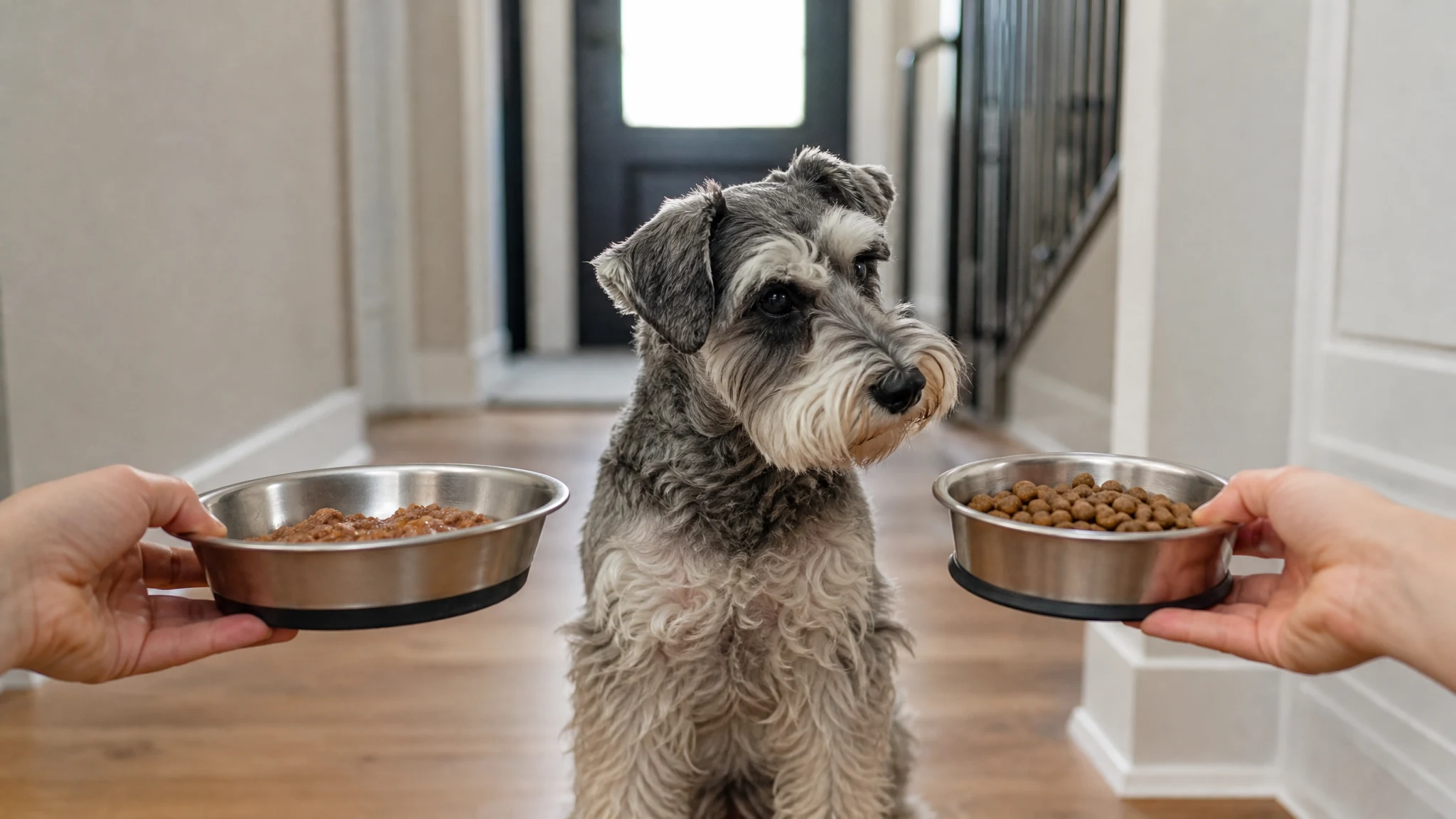
General nutrition information compiled from product labels and published sources, not veterinary advice. Your veterinarian is the right person to choose a diet for your dog, especially one with a health condition.
Pet stores sell raised bowls with confident claims on the box. Many owners of small dogs wonder if a Miniature Schnauzer needs one.
The honest answer is that bowl height is a smaller question than what is in the bowl and how much goes in. This guide shows you how to set up a dog feeding station, try both heights, and decide with your veterinarian. It makes no promises about health outcomes.
What the evidence says (and does not say)
Hill's Pet Nutrition describes the adult Miniature Schnauzer as a small dog. Males stand about 14 inches at the withers and females about 13 inches. Adults weigh 10 to 18 pounds, with males at 11 to 18 and females at 10 to 15.
That is a short dog. A bowl on the floor sits close to a comfortable eating position for most of them.
None of the breed sources we relied on say that raised bowls improve or harm Miniature Schnauzers. Claims that a raised bowl prevents or causes bloat, for example, are not supported by anything in the breed sources here. Treat any such claim on packaging with skepticism. If you worry about bloat, digestion, neck or joint comfort, ask your veterinarian about your individual dog.
So "does it matter?" has a practical answer: it can matter for comfort and mess, and it is worth testing, but it is not a substitute for good food choices and measured portions.
When a raised bowl might make sense
- Your dog seems to stretch, hunch or strain at a floor bowl.
- An older dog moves stiffly. Hill's lists a life expectancy of 12 to 14 years, so many Schnauzers spend years as seniors.
- Your dog flips or pushes a light bowl across the floor.
- You want a cleaner, more contained eating spot.
When floor feeding is fine
- Your dog eats comfortably, without gulping or straining.
- Your dog is a puppy still getting used to routines.
- Your vet has no concerns about posture or swallowing.
Materials you need
- A stainless steel or ceramic bowl with a non-slip base. These are easy to wash and do not hold odors the way scratched plastic can.
- A raised stand or feeder, only if you want to test an elevated setup. Choose one that does not wobble.
- A mat that catches spills and water.
- A measuring cup or a kitchen scale. Many labels give grams as well as cups.
- Your dog's current food and its label feeding guide.
- A notebook or phone note for tracking weight and meals.
- Your dog's regular treats, to build a positive routine.
Step by step: set up and test your dog feeding station
1. Pick a quiet, stable spot
Choose a corner away from foot traffic, the door and noisy appliances. Dogs that feel rushed tend to eat faster. A fixed place also helps house guests and children learn to leave your dog alone at meals.
Put the mat down first. Place the water bowl beside the food bowl, not inside the feeder, so you can wash each one on its own.
2. Measure your dog before you buy anything
Stand your dog on a flat floor and note where the chest ends and the legs begin. A raised bowl should sit roughly near the lower chest, so your dog can eat without reaching up or bending far down. Treat this as a starting guess. Dogs differ, and the breed ranges above are only a guide.
If you cannot tell, test with a sturdy box or a stack of books before you buy a stand.
3. Start with the floor and watch
Feed one or two meals at floor level. Watch your dog's posture, speed and mess. Look for:
- Gulping, gagging or coughing.
- Pushing the bowl around.
- Stiffness when standing up afterward.
- Dropping food outside the bowl.
If none of these show up, you may not need a raised feeder at all.
4. Try the raised setup for a few days
If you see a problem, borrow or build a temporary raised setup. Let your dog sniff it first. Reward calm approaches with a treat and praise. Never force a dog toward the bowl. Reward-based, patient introductions are the approach recommended by the American Veterinary Society of Animal Behavior (AVSAB).
Feed several meals in the new position. Compare what you see with step 3.
5. Measure the food, not just the bowl
This step matters more than the height. Pick the amount from the label guide on your dog's food, and treat it as a starting point. Then adjust based on your dog's body condition and your vet's advice. The label guides we checked say this themselves:
- Royal Canin Miniature Schnauzer Adult has a feeding table by weight and activity level. For an 11 pound (5 kg) dog with low activity it lists 1 cup (86 g) a day.
- VICTOR Hi-Pro Plus Small Breed Adult lists daily amounts by weight, from 1/2 cup for 5 pounds to 2 1/4 cups for 30 pounds, using a standard 8 ounce cup.
- Hill's Science Diet Adult Small & Mini tells owners to adjust amounts to maintain optimal weight, and to ask a veterinarian if unsure.
Calorie density differs between foods. Royal Canin lists 309 kcal per cup for its adult formula, Hill's lists 357 kcal per cup, and VICTOR lists 360 kcal per cup. A cup of one food is not the same as a cup of another, so never swap foods cup for cup. Check the new label.
For a broader look at portions by life stage, see our Miniature Schnauzer feeding chart by age.
Feeding times and number of meals are not set by the sources we used. Ask your veterinarian what schedule suits your dog, then keep it steady.
6. Slow down fast eaters
If your dog gulps, try splitting the daily amount into more meals, as your vet approves, or use a slow-feed bowl insert. Height does not fix speed by itself. A calm spot and measured portions often help more.
7. Keep it clean
Wash the bowls daily with hot soapy water and let them dry. Wipe the stand and mat every few days. Moisture under a feeder can build up, so check the floor too.
8. Review after two weeks
Compare your notes. Is your dog calmer, less messy, more comfortable? Or no different? If nothing changed, either setup is fine. Pick the one that is easiest for your household.
Special Schnauzer considerations
Some health topics for this breed relate to diet, though a feeding station does not address them. Science for Animal Welfare (formerly UFAW) states that the breed is predisposed to pancreatitis and to idiopathic hyperlipidaemia, meaning high triglycerides. It adds that the second condition is seen most often in middle-aged and older dogs and tends to worsen with age.
A paper in PubMed Central notes that the breed has a high risk for calcium oxalate urinary stones.
These are predispositions, not diagnoses. Whether your dog needs a low-fat or other special diet is a decision for your veterinarian. Prescription diets are only something a vet prescribes. If your dog has any health condition, confirm food type and amounts with your vet before changing anything, including the way you serve meals.
Do not change foods suddenly either. Introduce any new food gradually, as the brand's label or your vet advises.
Tips
- Choose a heavy base or rubber feet so the feeder cannot tip.
- Keep the routine boring and predictable. Calm dogs eat better.
- Weigh your dog every few weeks at home or at the clinic, and write it down.
- Count treats as part of the day's food.
- Store dry food in its original bag inside a sealed container, so you keep the batch information if a brand ever issues a notice.
- Feed multiple dogs in separate spots to avoid guarding.
Common mistakes to avoid
- Buying a tall feeder first. Too high is as awkward as too low for a 13 to 14 inch dog.
- Believing health claims on the box. No source here shows that a raised bowl prevents or treats any disease.
- Eyeballing portions. A heaped scoop can be much more than a level cup.
- Leaving food down all day. It makes portions hard to track.
- Copying a large-breed puppy plan. A Miniature Schnauzer's adult weight is far under the 70 pound AAFCO large-size threshold, so large-breed puppy rules do not apply. Puppy foods labeled for growth, including the "except for growth of large size dogs" version, are options to review with your vet.
- Skipping the vet conversation for a dog that coughs, gags, vomits or struggles to swallow at meals.
What to expect
Results vary. Some owners find a raised bowl makes eating look more comfortable, especially for an older dog. Others see little difference. A steady spot, a clean bowl and measured portions may reduce mess and rushed eating. They do not guarantee any health result.
The U.S. Food and Drug Administration (FDA) has said it has found no established causal link in its investigation of certain diets and canine dilated cardiomyopathy (DCM). Its last public update was December 23, 2022. This is not about bowl height, but it is a good reminder that food choices are best made with your vet using label data, not marketing.
For this article we looked at published label information. We did not run feeding trials or taste tests, and we did not test any feeder.
Quick decision guide
| Situation | Reasonable first step |
|---|---|
| Dog eats comfortably from the floor | Keep floor feeding and focus on portions |
| Dog strains or hunches | Test a raised bowl, and mention it to your vet |
| Dog gulps food | Try a slow-feed insert and a quiet spot |
| Dog coughs, gags or vomits at meals | Call your veterinarian before changing the setup |
| Dog has a health condition | Confirm food and amounts with your vet |
Sources
- Hill's Pet Nutrition: Miniature Schnauzer breed page
- Science for Animal Welfare: Miniature Schnauzer pancreatitis and hyperlipidaemia
- PubMed Central: Urogenital microbiome in Miniature Schnauzers with and without calcium oxalate urolithiasis
- FDA CVM: Investigation into potential link between certain diets and canine DCM
- Royal Canin: Miniature Schnauzer Adult
- Hill's Science Diet: Adult Small & Mini Chicken & Brown Rice
- VICTOR: Hi-Pro Plus Small Breed Adult