Dog Feeding Charts: Cups vs Grams for a Miniature Schnauzer
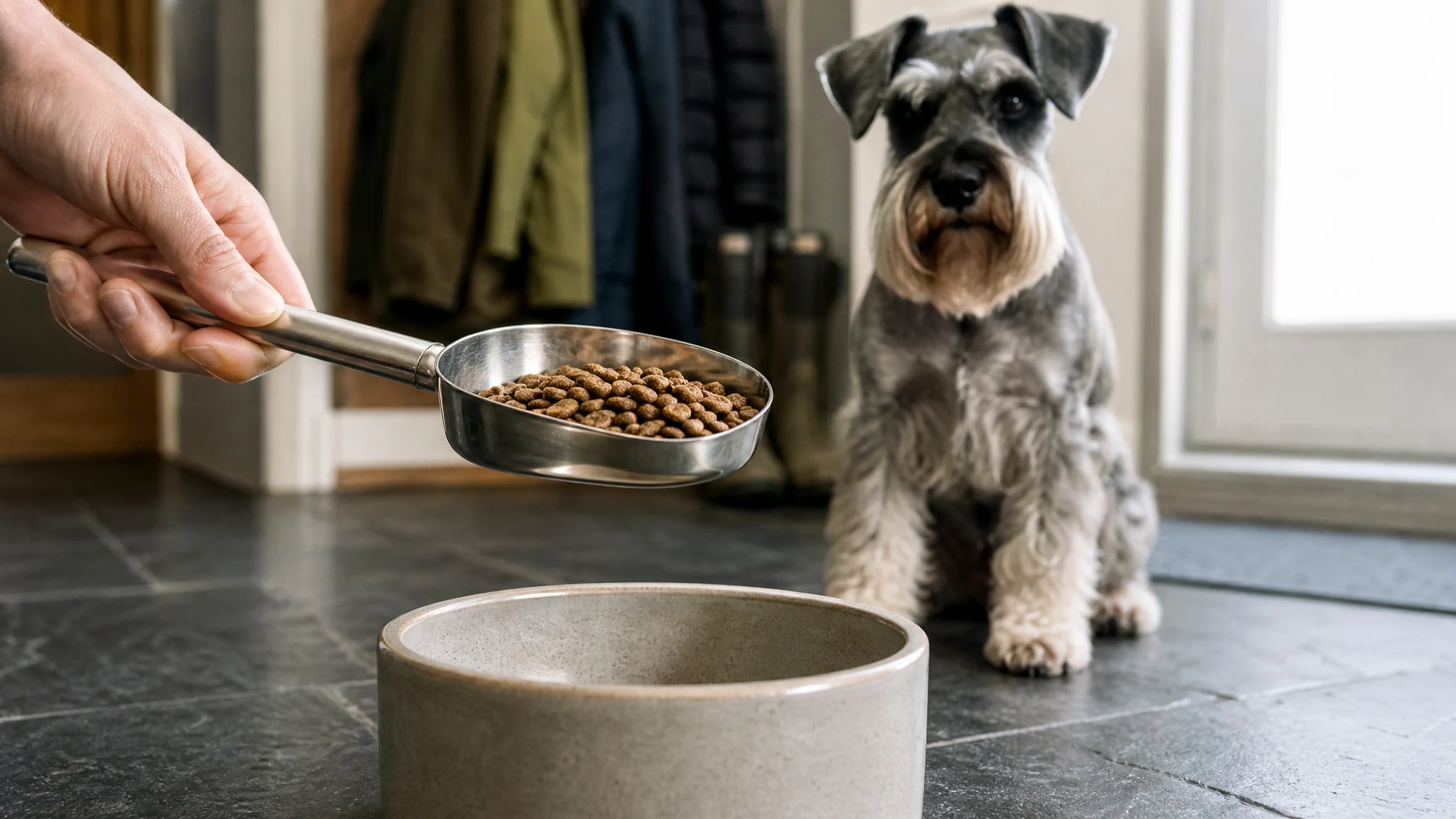
General nutrition information compiled from product labels and published sources, not veterinary advice. Your veterinarian is the right person to choose a diet for your dog, especially one with a health condition.
Every bag of dog food has a feeding chart. Most list amounts in cups. Some also list grams. For a small dog like a Miniature Schnauzer, that difference matters more than it looks.
Adult Miniature Schnauzers are small. Hill's Pet Nutrition lists males at 11 to 18 pounds and females at 10 to 15 pounds. A small dog has little room for error, so a scoop that runs a little heavy every day adds up.
This guide shows you how to read a dog feeding chart, convert cups to grams, and set a starting portion you can adjust with your veterinarian.
One note on method: we compared label data published by the brands. We did not run feeding trials or taste tests, and we did not feed any of these foods.
Why a cup is not a fixed amount of food
A cup measures volume. A gram measures weight. Kibble shapes, sizes and densities differ, so one cup of one food can weigh much less or much more than one cup of another.
The label data shows how wide the gap can be. Royal Canin's Miniature Schnauzer Adult dry food lists an 11 lb (5 kg) low activity dog at 1 cup, which the page gives as 86 g. Dividing the calories on each label by its weight gives a rough cup weight for other foods:
| Food (brand label data) | Calories listed per cup | Rough weight of one cup |
|---|---|---|
| Royal Canin Miniature Schnauzer Adult (dry) | 309 kcal ME, calculated | 86 g, per the feeding table |
| Hill's Science Diet Adult Small & Mini (dry) | 357 kcal (3699 kcal/kg) | about 97 g, our arithmetic |
| VICTOR Hi-Pro Plus Small Breed Adult (dry) | 360 kcal (3503 kcal/kg) | about 103 g, our arithmetic |
| Freshpet Small Dog Bite Size Chicken (fresh) | 267 kcal (1946 kcal/kg) | about 137 g, our arithmetic |
| Nom Nom Chicken Cuisine (fresh) | 244 kcal (calculated) | 219 g, per the brand |
The "about" figures are our own division of the listed calories by the listed calories per kilogram. Treat them as estimates, not brand claims. The point is that a cup of one food is not a cup of another.
Calories per cup also differ. Weigh out the same 86 g of two foods and you can end up with very different calorie totals. That is why switching foods and keeping "one cup" can quietly change how much your dog eats.
Materials you need
- The bag, can or tray of the food you are using, with the full feeding chart.
- A kitchen scale that reads in grams. A basic digital scale is enough.
- A standard 8 oz measuring cup. VICTOR's chart, for example, says it uses a standard 8 oz cup.
- Your dog's current weight, from a home scale or your veterinarian's office.
- A notebook or phone note to record amounts and weight checks.
How to convert cups to grams: step by step
Step 1: Find your dog's weight
Feeding charts run by body weight. Weigh your Miniature Schnauzer, or use the number from the last vet visit. For adults, the Hill's breed page puts the typical range at 10 to 18 pounds, but your dog's own weight is what counts.
A simple method is to weigh yourself, then weigh yourself holding your dog, and subtract.
Step 2: Find the matching row on the chart
Look for your dog's weight, and for activity level if the chart has one. Royal Canin's Miniature Schnauzer Adult table, for example, goes by weight and activity level. VICTOR's small breed chart lists daily amounts by weight, from 1/2 cup at 5 lbs up to 2 1/4 cups at 30 lbs.
Puppy charts work differently. Royal Canin's Miniature Schnauzer Puppy table goes by age from 2 to 9 months and expected adult weight. For age-based amounts, see our Miniature Schnauzer feeding chart by age.
Step 3: Note the total for the whole day
Chart amounts are daily totals, not per meal. Write down the daily number first. You split it into meals later.
Step 4: Weigh one cup of your food
Fill your measuring cup level with the food, pour it into a bowl on the scale, and read the grams. Repeat twice and average the readings. Kibble settles differently each time you scoop, which is the very reason grams are steadier.
If the brand already lists grams, such as the 86 g in the Royal Canin example, use the brand's figure as a cross-check against your own scale.
Step 5: Calculate the daily grams
Multiply the cups on the chart by the grams in one cup. Say a chart says 1 cup and your scale says one cup of your food weighs 90 g. Your starting daily amount is 90 g.
For a chart that says 3/4 cup, multiply 90 by 0.75. Your daily amount is 67.5 g.
Step 6: Split the day into meals
The label data we compared does not set a meal schedule for Miniature Schnauzers. Ask your veterinarian how many meals suit your dog. Whatever the number, divide the daily grams evenly and weigh each meal.
Step 7: Treat the chart as a starting point
Hill's says to adjust feeding amounts as necessary to maintain optimal weight and to ask your veterinarian if you are unsure. Every chart is an average. Your dog may need more or less depending on activity, age and metabolism.
Step 8: Record, check, adjust
Weigh your dog every few weeks and note the result. Feel the ribs and look at the waist from above. If weight creeps up or down, change the daily grams in small steps and recheck. Your veterinarian can tell you what a healthy body condition looks like for your dog.
Wet and fresh foods use different units
Not every chart is in cups. Hill's Science Diet Adult Small & Mini Savory Stew is a tray food, and its chart runs from 1 1/2 trays for a 2 lb dog to 10 trays for a 30 lb dog. The page lists 81 kcal per 3.5 oz (99 g) tray, though the wording is not fully explicit about per-tray, so confirm on the brand page.
Freshpet's Small Dog Bite Size Chicken chart gives 1/2 to 1 cup per day for 5 to 10 lb dogs. Nom Nom's guide gives 1 cup (218 g) per day for a 10 lb adult, and says amounts vary by age, weight and activity. JustFoodForDogs lists its Pantry Fresh pouch at 387.5 kcal per 12.5 oz pack, with the feeding guides shown as images on the page.
For these foods, weighing still helps, but the calories on the label matter most. Check the brand page for the current chart before you start.
Why a Miniature Schnauzer owner may want to be extra careful
Science for Animal Welfare (formerly UFAW) says the breed is predisposed to pancreatitis and to idiopathic hyperlipidaemia, meaning high triglycerides. It notes the latter is seen most often in middle-aged and older dogs and tends to worsen with age.
A PubMed Central study also describes a high risk for calcium oxalate urinary stones in the breed.
These are predispositions, not diagnoses, and no food is shown here to prevent or treat them. What they mean for feeding is practical. Steady, measured portions make it easier for you and your veterinarian to see changes. If your dog has any health condition, or if you are thinking about a low-fat diet, confirm amounts and the choice of food with your veterinarian before changing anything. Prescription diets are something only a veterinarian prescribes.
Tips
- Weigh the food, not the scoop. Grams do not change with how the kibble settles.
- Re-weigh a cup whenever you change foods or bag types.
- Count treats and table scraps as part of the day's food. If your dog gets many treats, ask your veterinarian whether to trim meals.
- Use the calories on the label, not cups, when comparing two foods. Hill's Science Diet Adult 7+ Small & Mini lists 359 kcal per cup, while the Royal Canin Miniature Schnauzer Adult lists 309.
- Check the AAFCO statement for your dog's life stage. A Miniature Schnauzer's adult weight is far below the 70 lb threshold, so a food labeled "except for growth of large size dogs" is acceptable for a puppy of this breed.
- Switch foods gradually, and ask your veterinarian how to do it for your dog.
Common mistakes to avoid
- Using the old cup with a new food. A different kibble can weigh and count differently per cup.
- Heaping the scoop. A heaped cup can hold noticeably more than a level one.
- Reading a puppy chart for an adult. Royal Canin's breed puppy food is intended up to 10 months, then the brand directs a transition to adult food. Check each brand's own life-stage guidance, since the facts we compared do not say when every Miniature Schnauzer counts as an adult.
- Treating dry matter numbers as guarantees. Some Hill's pages give averages on a dry matter basis, not guaranteed minimums. Do not compare them directly with as-fed minimums on other labels.
- Ignoring weight changes. The chart is a start. Your dog's body is the real check.
- Never confirming with the vet. A dog with a health condition may need a different amount than any chart gives.
What to expect
Weighing portions may help you feed more consistently from day to day. Many owners find that it makes weight changes easier to spot and discuss with their veterinarian. Results vary by dog, and a scale does not replace veterinary advice.
Expect to adjust over several weeks rather than get it right on day one. Small changes, followed by a recheck, are usually easier to manage than big swings.
Quick recap
- Get your dog's current weight.
- Find the row on the label's dog feeding chart.
- Note the daily total.
- Weigh one level cup of the food.
- Multiply cups by grams per cup.
- Split into meals as your veterinarian advises.
- Treat it as a starting point and adjust.
- Record weight and recheck every few weeks.
Sources
- Hill's Pet Nutrition: Miniature Schnauzer breed page
- Science for Animal Welfare: Miniature Schnauzer pancreatitis and hyperlipidaemia
- PubMed Central: Urogenital microbiome in Miniature Schnauzers with and without calcium oxalate urolithiasis
- Royal Canin: Miniature Schnauzer Adult
- Royal Canin: Miniature Schnauzer Puppy
- Hill's Science Diet: Adult Small & Mini
- Hill's Science Diet: Adult 7+ Small & Mini
- Hill's Science Diet: Adult Small & Mini Savory Stew
- VICTOR: Hi-Pro Plus Small Breed Adult
- Freshpet: Small Dog Bite Size Chicken Recipe
- Nom Nom: Chicken Cuisine
- JustFoodForDogs: Pantry Fresh Chicken & Rice Recipe