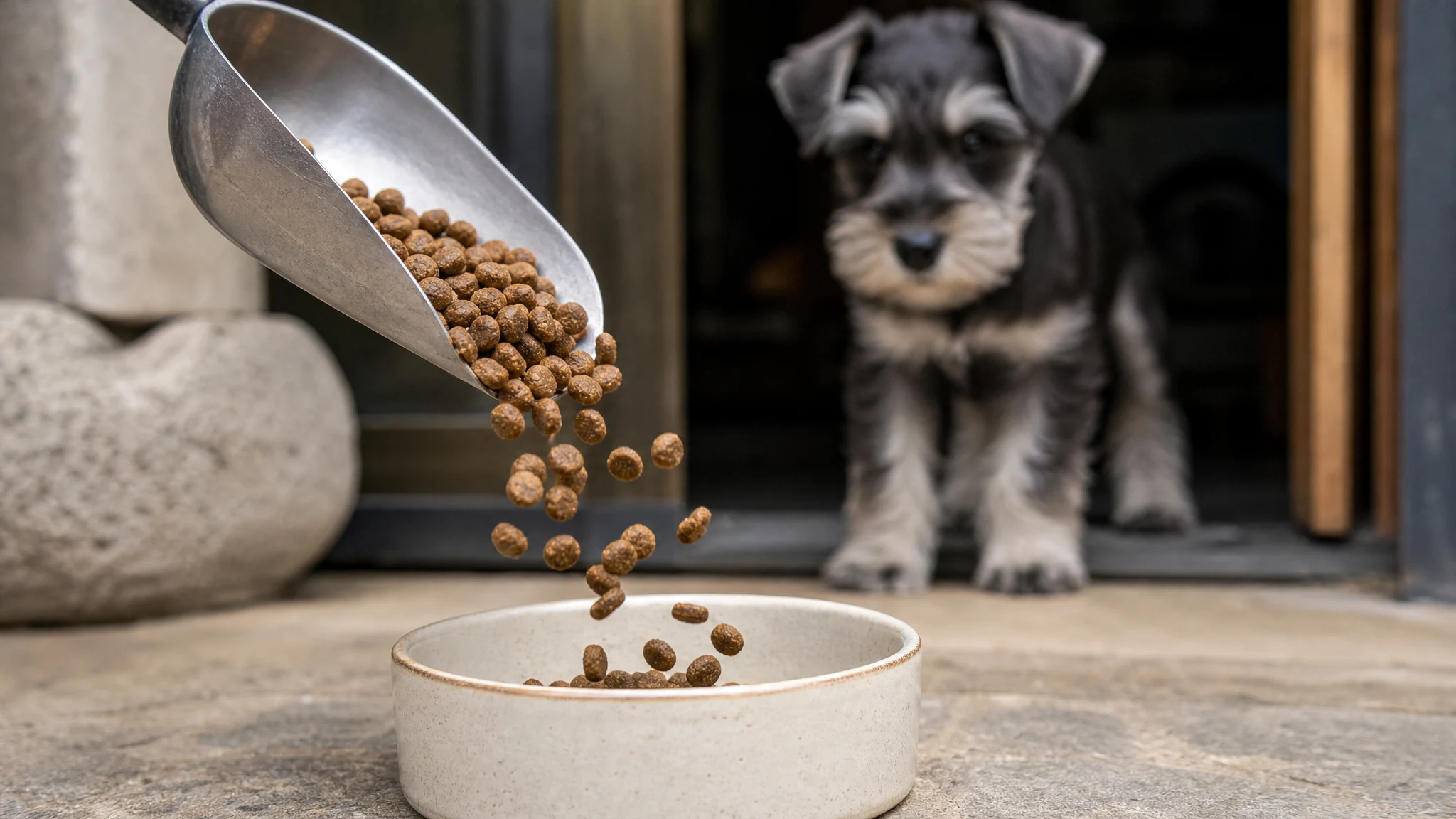
Best Dry Dog Food for a Miniature Schnauzer Puppy
General nutrition information compiled from product labels and published sources, not veterinary advice. Your veterinarian is the right person to choose a diet for your dog, especially one with a health condition.
Choosing the best dry dog food for a Miniature Schnauzer puppy is mostly a label-reading job. Bag fronts promise a lot. The back of the bag tells you what the food actually is.
This guide walks you through that process in order. We compared label data from the brands' own pages: the AAFCO statement, life stage, protein, fat, calories and first ingredients. We did not run feeding trials or taste tests, and nothing here says one food is right for every puppy.
What You Need Before You Start
- The bag or the brand's product page for each food you are considering.
- Your puppy's age and current weight.
- A kitchen scale or a standard measuring cup.
- A notebook or phone note to record what you compare.
- The name of your veterinarian, who has the final say on your puppy's diet.
Know the Dog You Are Feeding
According to the Hill's Pet Nutrition breed page, adult Miniature Schnauzer males weigh 11 to 18 lbs and females 10 to 15 lbs. That makes the breed a small dog. The same page gives a life expectancy of 12 to 14 years.
The size matters for one label detail. AAFCO foods for growth carry wording about large size dogs (70 lb or more as an adult). A Miniature Schnauzer will be far below that. So a puppy can eat a food labeled for growth, or for all life stages, including the "except for growth of large size dogs" version. Large-breed puppy rules do not apply to this breed.
Step-by-Step: How to Pick a Dry Puppy Food
Step 1: Find the AAFCO statement
Look for a sentence saying the food is formulated to meet AAFCO Dog Food Nutrient Profiles, or substantiated by AAFCO feeding tests. For a puppy it should say "growth" or "all life stages." If it says only "maintenance," it is an adult food.
Reading the exact wording is worth the minute. A bag labeled for adults can look similar to a puppy bag on the shelf.
Step 2: Match the life stage
Puppy foods are written for growing dogs. Royal Canin's Miniature Schnauzer Puppy is described for purebred puppies from 8 weeks to 10 months. Royal Canin's page says to move to the adult formula after 10 months. Hill's Science Diet Puppy Small & Mini is a growth food that also covers gestating or lactating adult females.
Step 3: Compare protein, fat and calories
Puppies use energy fast, so calories per cup matter for measuring. Protein and fat percentages are best compared the same way on every food. Pay attention to how each brand reports them. Some give guaranteed minimums. Hill's gives dry matter averages instead, which are not the same thing and should not be lined up directly against minimums.
The table below lists label data from each brand's page for dry puppy foods that suit a small breed.
| Food | AAFCO wording | Protein | Fat | Calories per cup |
|---|---|---|---|---|
| Royal Canin Miniature Schnauzer Puppy | Growth, including large size dogs | 28% min | 12% min | 341 kcal ME (calculated) |
| Royal Canin Small Puppy | Growth, including large size dogs | 29% min | 18% min | 349 kcal ME (calculated) |
| Hill's Science Diet Puppy Small & Mini Chicken & Brown Rice | Growth, substantiated by feeding tests | 28.9% dry matter (not a minimum) | 19.7% dry matter (not a minimum) | 418 kcal |
| VICTOR Hi-Pro Plus Small & Medium Breed Puppy | All life stages, except growth of large size dogs | 30% min | 18% min | 383 kcal |
Notice the spread in fat and calories. The Royal Canin Miniature Schnauzer Puppy lists the lowest fat minimum and calorie count of the four. That is a label fact, not a verdict on any food.
Step 4: Read the first five ingredients
Ingredients are listed by weight before cooking, so the first few give a rough picture. Here is what each brand's page lists:
- Royal Canin Miniature Schnauzer Puppy: chicken by-product meal, brewers rice, brown rice, wheat, wheat gluten.
- Royal Canin Small Puppy: chicken by-product meal, brewers rice, chicken fat, wheat gluten, corn.
- Hill's Science Diet Puppy Small & Mini: chicken, whole grain oats, brown rice, chicken meal, chicken fat.
- VICTOR Hi-Pro Plus Small & Medium Breed Puppy: beef, chicken, beef meal, chicken meal, whole grain sorghum.
None of these is grain-free. A long ingredient list does not make a food better or worse by itself. Use it to spot anything your puppy has reacted to, and to compare foods fairly.
Step 5: Think about the breed's fat and weight questions
Science for Animal Welfare (formerly UFAW) says Miniature Schnauzers are predisposed to pancreatitis and to idiopathic hyperlipidaemia, which means high triglycerides. It notes this is seen most often in middle-aged and older dogs. A puppy is not a dog with those conditions, but the breed history is a good reason to raise diet with your veterinarian early.
Ask whether a moderate-fat food suits your puppy, and how to keep treats and table scraps in check. A veterinarian decides what is right for an individual dog. Food labels cannot tell you that.
Step 6: Check the feeding guide and kibble size
Every brand prints a feeding guide. Treat it as a starting point, not a rule. Royal Canin's Miniature Schnauzer Puppy table is organized by age and expected adult weight. VICTOR lists cups per day by life stage and body weight. Hill's says to adjust amounts as needed to maintain optimal weight.
The brand pages we reviewed did not give a kibble measurement for these puppy foods. If your puppy struggles with the piece size, contact the brand or ask your veterinarian.
Step 7: Choose, then transition slowly
Pick one food that fits your life stage, label and budget checks. Mix it into the old food over about a week, increasing the new share gradually. Brands print their own transition advice, so follow it. Keep the same food for a while before judging it.
Step 8: Track and adjust
Weigh your puppy regularly and note appetite, stool quality and energy. Share those notes at vet visits. Adjust the portion if your puppy is gaining too fast or looks thin, and ask your veterinarian before changing foods.
Tips That Make the Process Easier
- Compare foods with the same method. Minimums against minimums, and dry matter figures against dry matter figures.
- Keep the bag, or a photo of the label, so you can check the lot and wording later.
- Count treats as part of the day's food.
- Use a measuring cup or scale every time. Scooping by eye drifts upward.
- Check the brand's own page for current label data, because formulas can change.
Common Mistakes to Avoid
- Feeding an adult food by accident. A "maintenance" statement means it is not made for growth.
- Assuming the breed name means a better food. A breed-specific bag is still judged by its label like any other.
- Switching suddenly. Abrupt changes often upset a puppy's stomach.
- Following the chart blindly. The guide is a starting point. Your puppy's body condition is the real check.
- Treating a food as a medical answer. No food prevents or treats pancreatitis, allergies or any other condition. Prescription diets come only from a veterinarian.
- Skipping the DCM headlines without context. The FDA's investigation into diet and canine dilated cardiomyopathy, last updated December 23, 2022, says adverse event reports alone do not show a cause. The agency said it would not release further public updates until there is meaningful new scientific information. Check the FDA page for anything newer.
What to Expect
A food that suits your puppy may be associated with steady appetite, regular stools and a healthy body condition over the first weeks. Results vary from dog to dog, and no food can promise a particular outcome. If you see vomiting, ongoing loose stools, itching or a drop in appetite, contact your veterinarian.
Plan to review the food again as your puppy grows. Royal Canin's page points to the move to adult food after 10 months for its breed formula. For other brands, check the label or ask your veterinarian when to change.
Where to Go Next
If you want to see dry, wet and fresh options side by side, read our comparison of foods for Miniature Schnauzers. It uses the same label-only method.
Sources
- Hill's Pet Nutrition: Miniature Schnauzer breed page
- Science for Animal Welfare: Miniature Schnauzer pancreatitis and hyperlipidaemia
- FDA CVM: Investigation into potential link between certain diets and canine dilated cardiomyopathy
- Whole Dog Journal: In the Fine Print, Nutritional Adequacy Statements
- Royal Canin: Miniature Schnauzer Puppy
- Royal Canin: Small Puppy
- Hill's Science Diet: Puppy Small & Mini
- VICTOR: Hi-Pro Plus Small & Medium Breed Puppy