Best Dog Food for Miniature Schnauzers: Foods Compared by Label Data
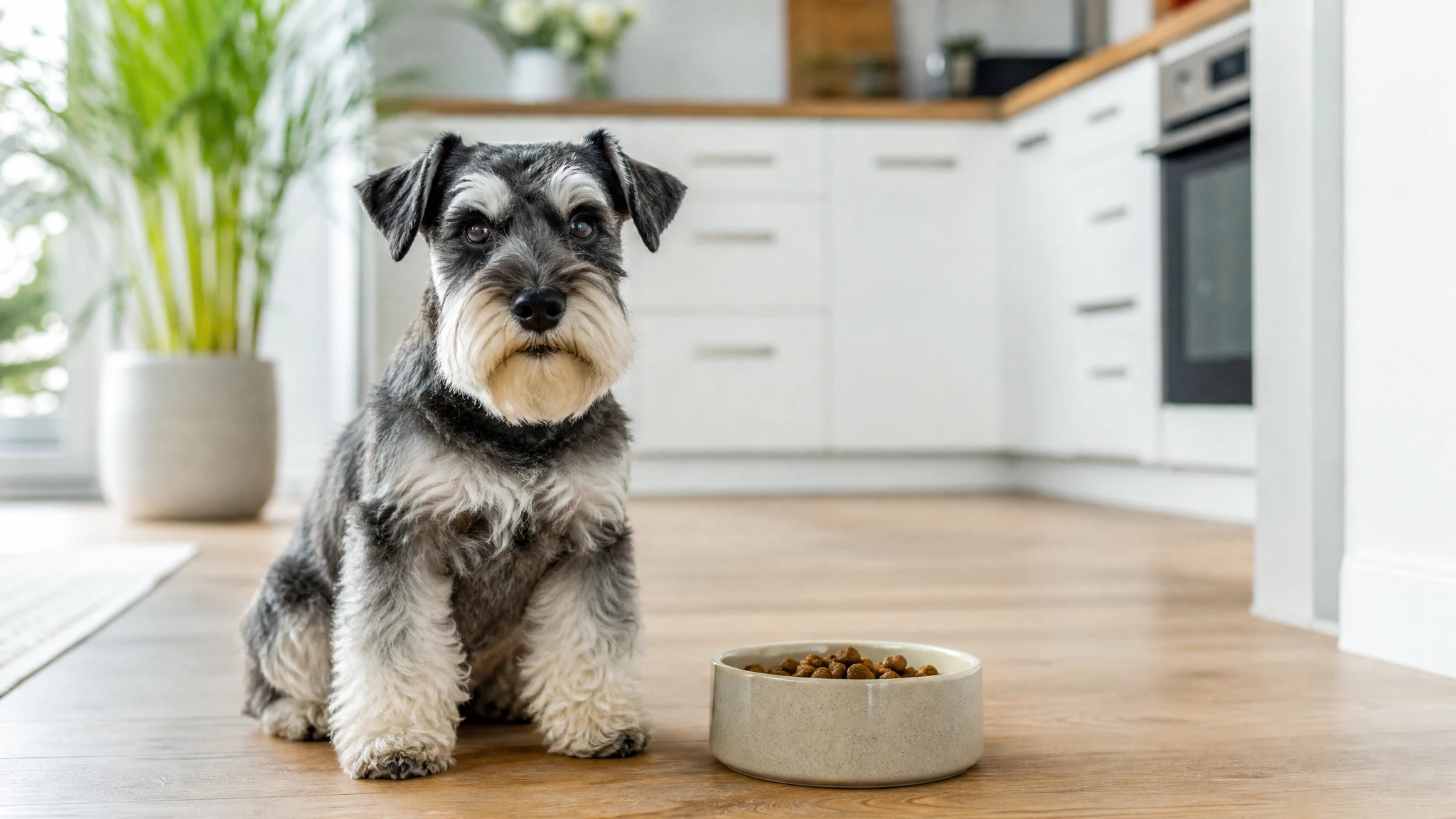
General nutrition information compiled from product labels and published sources, not veterinary advice. Your veterinarian is the right person to choose a diet for your dog, especially one with a health condition.
Choosing the best dog food for Miniature Schnauzers is mostly a matter of reading labels carefully and matching them to a small dog with a few known dietary tendencies. This guide shows what the labels say, who each food may suit, and what to ask your veterinarian before you switch.
No food here is crowned as the single best. The right food depends on your dog's age, weight, activity and health history. What this page can do is make the comparison fair and transparent.
How we compared these foods
We compared label data published on each brand's own product page. That means the AAFCO nutritional adequacy statement, life stage, guaranteed analysis (protein, fat, fiber), calories per cup, the first five ingredients and kibble size where the brand gives it.
We did not run feeding trials. We did not taste test anything. We did not feed these foods to dogs, and we make no claim about how any dog did on them. If a number was not on the brand page, we say it is unknown instead of guessing, and you should check with the brand.
We also left out prices, ratings and recall history. Prices change by store and by week, and we have no verified source for the others, so we do not quote them.
Why label data has limits
A label tells you what a food is formulated to contain. It does not tell you how a particular dog will digest it, or whether your dog will eat it. Treat the comparison below as a shortlist builder, not a verdict.
Also be careful comparing numbers across food types. Dry food, wet food and fresh food hold very different amounts of water. A guaranteed analysis on an as-fed basis looks very different from the same food on a dry matter basis. Hill's, for example, publishes dry matter averages on its pages, while Royal Canin and VICTOR publish guaranteed minimums and maximums. Those are not the same kind of number, so we avoid ranking them against each other directly.
What to look for on a Miniature Schnauzer food label
1. A complete and balanced statement
Look for the AAFCO statement, usually near the guaranteed analysis. It should say the food is complete and balanced for a stated life stage: growth, maintenance, or all life stages. A food without this statement is meant for treats or supplemental feeding, not as a main diet.
There are two common ways a brand reaches that statement. Some foods are formulated to meet the AAFCO nutrient profiles. Others add that animal feeding tests using AAFCO procedures substantiate the claim. Both are legitimate routes, and the label tells you which one the brand used. Among the foods below, the Hill's Science Diet dry foods use the feeding test wording, while the Royal Canin, VICTOR, Freshpet, Nom Nom and JustFoodForDogs foods use the formulated to meet wording.
2. The life stage wording
Adult Miniature Schnauzers weigh roughly 10 to 18 lbs, according to the Hill's Pet Nutrition breed page: males 11 to 18 lbs and females 10 to 15 lbs. That is far under the 70 lb adult weight in AAFCO's large size dog wording.
This matters for puppies. Growth and all life stages foods carry either "including growth of large size dogs" or "except for growth of large size dogs" on the label. The "except" version is aimed at foods that should not be fed to large-breed puppies, as the Whole Dog Journal explains in its guide to nutritional adequacy statements. For a small breed like this one, either wording is workable, so an "except for growth of large size dogs" label is not a warning sign here.
3. Protein, fat and fiber numbers
These are guaranteed minimums (protein, fat) and maximums (fiber), not exact amounts. Fat deserves special attention for this breed, which we cover in the breed section below.
4. Calories per cup
Miniature Schnauzers are small, so a few extra kibbles add up. Calories per cup tell you how much a cup really delivers. In the dry foods below they range from 309 to 418 kcal per cup, which is a wide spread for a measuring cup of similar-looking kibble.
5. The first five ingredients
Ingredients are listed by weight before cooking, so water-heavy ingredients such as fresh chicken can sit high on the list and weigh less in the finished food. The first five ingredients are a useful glimpse of the recipe, not a quality score. Be skeptical of any food that sells itself on one ingredient alone.
6. Kibble size
Small mouths often do better with smaller kibble, but the brands here rarely publish a measurement. Only one page, Hill's Adult 7+ Small & Mini, says "nibble size kibble", and VICTOR describes bite-sized kibble without giving dimensions. For the rest, kibble size is unknown from the label, so check with the brand or look at a small sample bag.
Breed diet points worth knowing
These are predispositions, not diagnoses. A predisposed breed is more likely than average to develop a problem, and many Miniature Schnauzers never do.
Pancreatitis and high triglycerides
Science for Animal Welfare (formerly UFAW) notes that the Miniature Schnauzer is predisposed to pancreatitis. It also describes idiopathic hyperlipidaemia (high triglycerides) as a predisposition in the breed, seen most often in middle-aged and older dogs and tending to worsen with age. The source says this is probably related to the breed's tendency to have high triglycerides.
For a label reader, the takeaway is practical: pay attention to fat content, and ask your veterinarian whether a lower-fat food is right for your individual dog. Do not choose or change a diet on your own to manage any of these conditions. A veterinarian decides that, and prescription diets are something only a veterinarian prescribes.
Urinary stones
A paper in PubMed Central on the urogenital microbiome of Miniature Schnauzers describes the breed as having a high risk for calcium oxalate stones. Diet and water intake are often part of the conversation about urinary health, but no label on these pages makes a claim about stones, and no food here should be assumed to affect them. Ask your veterinarian about urinary management if it is a concern.
Lifespan and size
Hill's gives a life expectancy of 12 to 14 years, though other sources give slightly different ranges. A long life means several life stages on a small frame, so you may buy more than one type of food over the years.
About grain-free and the FDA
Some foods below are labeled grain-free and some are not. The FDA's investigation into a potential link between certain diets and canine dilated cardiomyopathy (DCM) was last updated on December 23, 2022. The FDA said it does not intend to release further public updates until there is meaningful new scientific information, and the page does not establish a causal link. Adverse event reports alone do not show causation. We did not check for later updates beyond that page, so look at the FDA page and ask your veterinarian if you have questions about grain-free diets.
The foods compared, by situation
Every food below appears with its label data. Feeding amounts are label guides, shown as starting points. Adjust to your dog's body condition with your veterinarian's help.
Adult dry food
Three dry foods are labeled for adult small dogs.
- Royal Canin Miniature Schnauzer Adult Dry: a breed-specific formula for purebred Miniature Schnauzers 10 months and older. The label states formulated to meet AAFCO maintenance levels. First five ingredients: brewers rice, brown rice, oat groats, corn gluten meal, wheat gluten. Protein 23.0% minimum, fat 10.0% minimum, fiber 3.7% maximum. It lists 309 kcal ME per cup (calculated). The feeding table gives 1 cup (86 g) for an 11 lb, low activity dog. Kibble size is not given.
- Hill's Science Diet Adult Small & Mini Chicken & Brown Rice: for adult dogs 1 to 6 years, up to 25 lb. Animal feeding tests using AAFCO procedures support the maintenance claim. First five ingredients: chicken, brown rice, whole grain wheat, whole grain corn, brewers rice. The page gives dry matter averages of 25% protein, 15.3% fat and 1.5% fiber, not guaranteed minimums. It lists 357 kcal per cup. Kibble size is unknown.
- VICTOR Hi-Pro Plus Small Breed Adult: labeled for all life stages except growth of large size dogs. First five ingredients: beef, chicken meal, beef meal, brown rice, whole grain millet. Protein 30.0% minimum, fat 14.0% minimum, fiber 5.0% maximum. It lists 360 kcal per cup. The chart runs from 1/2 cup for 5 lbs to 2 1/4 cups for 30 lbs, using a standard 8 oz cup.
Who each may suit: The Royal Canin food has the lowest minimum fat and the lowest calorie count per cup of the three, and it is built for this breed. That is a label fact, not a health claim. It is also the only one of the three with corn gluten meal and wheat gluten as top ingredients, which matters if you want a meat-first list. The VICTOR food has the highest protein and a meat-first list, and also a higher minimum fat. Hill's offers a feeding-test-backed claim and a chicken-first list. Compare the fat figures with your veterinarian if pancreatitis or high triglycerides are a concern in your dog's history.
Puppy food
Miniature Schnauzer puppies grow into a small adult, so any of these growth or all life stages foods are in range for the breed. Ask your veterinarian about when to move to adult food.
- Royal Canin Miniature Schnauzer Puppy Dry: for purebred puppies 8 weeks to 10 months. Label wording covers growth including growth of large size dogs. First five ingredients: chicken by-product meal, brewers rice, brown rice, wheat, wheat gluten. Protein 28.0% minimum, fat 12.0% minimum, fiber 3.9% maximum. It lists 341 kcal per cup. The feeding table goes by age (2 to 9 months) and expected adult weight (8.8 lb, 13 lb or 18 lb), and the page says to transition to adult food after 10 months.
- Royal Canin Small Puppy Dry (formerly Mini Puppy): for puppies up to 10 months with an expected adult weight of 9 to 22 lbs. First five ingredients: chicken by-product meal, brewers rice, chicken fat, wheat gluten, corn. Protein 29.0% minimum, fat 18.0% minimum, fiber 3.9% maximum. It lists 349 kcal per cup. The feeding guide is an image that links to a calculator, so the amounts are not readable as text.
- Hill's Science Diet Puppy Small & Mini Chicken & Brown Rice: supported by AAFCO feeding tests for growing puppies and for gestating or lactating adult females. First five ingredients: chicken, whole grain oats, brown rice, chicken meal, chicken fat. Dry matter figures are 28.9% protein, 19.7% fat and 2.3% crude fiber. It lists 418 kcal per cup, the highest of any dry food here.
- VICTOR Hi-Pro Plus Small & Medium Breed Puppy: labeled for all life stages except growth of large size dogs. First five ingredients: beef, chicken, beef meal, chicken meal, whole grain sorghum. Protein 30.0% minimum, fat 18.0% minimum, fiber 5.0% maximum. It lists 383 kcal per cup.
Who each may suit: The breed-specific Royal Canin puppy formula has the lowest minimum fat and calories here, and its feeding table is built around Miniature Schnauzer adult weights. The other three are more energy dense, with 349 to 418 kcal per cup. A calorie-dense puppy food needs smaller portions, so follow the label guide as a starting point and watch body condition. A puppy that is growing is not a dog to put on a restrictive diet, so lean on your veterinarian for this stage.
Senior food
Only one senior option is in our label data.
- Hill's Science Diet Adult 7+ Small & Mini Chicken & Brown Rice: a maintenance food supported by AAFCO feeding tests. First five ingredients: chicken, brown rice, whole grain wheat, whole grain corn, brewers rice. Dry matter averages are 21.5% protein, 15% fat and 3.7% crude fiber. It lists 359 kcal per cup and uses nibble size kibble.
Who it may suit: Owners of small dogs 7 and older who want a small kibble and a feeding-test-backed claim. Note that the calories per cup are nearly the same as the adult version, so older, less active dogs may still need careful portion control. Because high triglycerides tend to worsen with age in this breed, according to Science for Animal Welfare, a senior Miniature Schnauzer is a good reason for a veterinary check before changing food.
Weight control
None of the foods in our label data is labeled as a weight management or light formula, so we do not name a weight control pick. What the labels do give you is calories per cup, which you can compare.
Among the dry foods, Royal Canin Miniature Schnauzer Adult is the lowest at 309 kcal per cup. Hill's wet Savory Stew lists 81 kcal per can (823 kcal/kg), though the page wording does not explicitly confirm that figure is per tray. Freshpet Small Dog lists 267 kcal per cup and Nom Nom Chicken Cuisine lists 244 kcal per cup. Cups of different foods are not equal in weight or moisture, so do not treat that as an automatic fit.
If your dog needs to lose weight, ask your veterinarian for a target and a daily calorie amount. Hill's own pages say to adjust amounts to maintain optimal weight and to ask your veterinarian if you are unsure.
Sensitive stomach
No food in our label data carries a sensitive stomach claim, so we cannot recommend one for that purpose. Digestive upset can have many causes, including medical ones, and a food change is not a safe first guess.
If your dog has vomiting, loose stools or poor appetite, call your veterinarian before experimenting. Any trial of a new food should be planned with them, since this breed is predisposed to pancreatitis according to Science for Animal Welfare.
Wet food
- Hill's Science Diet Adult Small & Mini Savory Stew with Chicken & Vegetables: a 3.5 oz (99 g) tray formulated to meet AAFCO maintenance levels. First five ingredients: chicken broth, chicken, pork liver, brown rice, carrots. Dry matter averages are 29.2% protein, 18.5% fat and 2.2% crude fiber. The feeding chart runs from 1 1/2 trays for a 2 lb dog to 10 trays for a 30 lb dog.
Who it may suit: Owners who want a wet option for a small dog, either as a main meal or in line with a veterinarian's plan. The dry matter fat average of 18.5% looks high next to dry foods, but that figure removes water, so it is not directly comparable to as-fed minimums on a dry kibble bag. Mixing foods changes the calorie count, so adjust the portions together.
Fresh food
Three fresh options are in the label data. All are labeled grain-free or grain-inclusive as noted, and none gives a kibble size.
- Freshpet Small Dog Bite Size Chicken Recipe: labeled for all life stages except growth of large size dogs. Grain-free. First five ingredients: chicken, chicken liver, carrots, cranberries, eggs. Protein 16% minimum, fat 12% minimum, fiber 1.5% maximum. It lists 267 kcal per cup. A 5 to 10 lb dog gets 1/2 to 1 cup per day under the brand's guide.
- Nom Nom Chicken Cuisine: labeled for all life stages including growth of large size dogs. Grain-free. First five ingredients: chicken, sweet potatoes, squash, spinach, dicalcium phosphate. Protein 6.5% minimum, fat 4.5% minimum, fiber 3.5% maximum. It lists 244 kcal per cup (calculated). The brand guide lists 1 cup (218 g) per day for a 10 lb adult, with amounts varying by age, weight and activity.
- JustFoodForDogs Pantry Fresh Chicken & Rice Recipe: a shelf-stable pouch labeled for all life stages including growth of large size dogs. Contains rice. First five ingredients: chicken breast, chicken thighs, chicken liver, long-grain white rice, kale. Protein 6.5% minimum, fat 2.5% minimum, fiber 1.0% maximum. A 12.5 oz pack is 387.5 kcal (1093 kcal/kg). A per-cup figure is not stated, and the feeding guides are images.
Who each may suit: Owners who prefer fresh or gently cooked foods and are comfortable with the different storage and handling that come with them. Percentages look low because of the high moisture, so do not read 6.5% protein as weak next to 23% on a dry bag. Compare calories and feeding amounts instead. The brand's own page is the place to check storage and serving details. Note that Nom Nom is not sized for small dogs specifically, so portions need care at 10 to 18 lbs.
Side by side: the dry foods
| Food | Life stage | Protein min | Fat min | Fiber max | kcal per cup |
|---|---|---|---|---|---|
| Royal Canin Miniature Schnauzer Adult | Adult | 23.0% | 10.0% | 3.7% | 309 |
| Royal Canin Miniature Schnauzer Puppy | Puppy | 28.0% | 12.0% | 3.9% | 341 |
| Royal Canin Small Puppy | Puppy | 29.0% | 18.0% | 3.9% | 349 |
| VICTOR Hi-Pro Plus Small Breed Adult | All life stages except large growth | 30.0% | 14.0% | 5.0% | 360 |
| VICTOR Hi-Pro Plus Small & Medium Puppy | All life stages except large growth | 30.0% | 18.0% | 5.0% | 383 |
The Hill's dry foods are left out of this table because the brand gives dry matter averages, not guaranteed minimums. Their calories per cup are 357 (adult), 359 (Adult 7+) and 418 (puppy).
Top picks at different price points
We do not rank foods by price. Prices vary by retailer, bag size and region, and we have no verified price data, so we will not state or imply one. Check the brand's own page or your usual store for current prices.
You can still shop smartly. Compare cost per day, not cost per bag. A calorie-dense food at 418 kcal per cup needs less volume than one at 309, so a bag may last longer than it seems. Fresh and wet foods have more water and fewer calories per cup, so they usually cost more per calorie, though check the brand before assuming.
Red flags to avoid
- No AAFCO statement. Without it, you cannot tell whether a food is a full diet.
- Disease claims. A food that says it prevents, treats or cures pancreatitis, allergies, urinary stones, DCM, bloat or hip dysplasia is making a claim a regular dog food should not. A veterinarian decides diet for an individual dog.
- Marketing in place of data. Words like "premium", "natural" or "holistic" are not nutrient information. Look for the numbers.
- No calorie information. If you cannot find calories per cup or per kilogram, you cannot portion the food well for a small dog.
- Ignoring life stage. An adult maintenance food is not designed for a growing puppy, and a puppy food may be too rich for an inactive senior.
- Large-breed advice applied to a small dog. Rules about large size growth do not apply to a dog with an adult weight of 10 to 18 lbs.
- Big switches overnight. Change foods gradually and talk to your veterinarian, especially for a breed predisposed to pancreatitis.
- Treats and table scraps that add up. In a small dog, they can crowd out the balanced food and add fat.
Where to buy
The simplest place to start is the brand's own product page, which lists the current label data. Each food above links there. Most brands also list where their foods are sold, and your veterinarian's office can tell you which stores carry what.
When you buy, compare the bag in your hands to the web page. Formulas change, and the bag is the final word on ingredients, guaranteed analysis and the AAFCO statement. Check the best-by date, choose a bag size your dog can finish in a reasonable time, and store it sealed. If a page and a bag disagree, ask the brand.
A practical way to choose
- Start with life stage: puppy, adult or senior.
- Check for a complete and balanced AAFCO statement.
- Compare calories per cup, then fat.
- Read the first five ingredients for anything your dog has had trouble with before.
- Ask your veterinarian about fat, urinary health and weight, using your dog's history.
- Follow the label feeding guide as a starting point, then adjust for body condition.
- Switch gradually and watch appetite, stool and energy.
The best food for Miniature Schnauzers is the one that matches the individual dog and that your veterinarian is comfortable with. Label data narrows the field, but your dog's own history decides.
Sources
- Hill's Pet Nutrition: Miniature Schnauzer breed page
- Science for Animal Welfare: Miniature Schnauzer pancreatitis and hyperlipidaemia
- PubMed Central: Urogenital microbiome in Miniature Schnauzers with and without calcium oxalate urolithiasis
- FDA CVM: Investigation into Potential Link between Certain Diets and Canine Dilated Cardiomyopathy
- Whole Dog Journal: In the Fine Print, Nutritional Adequacy Statements
- Royal Canin: Miniature Schnauzer Adult
- Royal Canin: Miniature Schnauzer Puppy
- Royal Canin: Small Puppy
- Hill's Science Diet: Adult Small & Mini
- Hill's Science Diet: Puppy Small & Mini
- Hill's Science Diet: Adult 7+ Small & Mini
- Hill's Science Diet: Adult Small & Mini Savory Stew
- VICTOR: Hi-Pro Plus Small Breed Adult
- VICTOR: Hi-Pro Plus Small & Medium Breed Puppy
- Freshpet: Small Dog Bite Size Chicken Recipe
- Nom Nom: Chicken Cuisine
- JustFoodForDogs: Pantry Fresh Chicken & Rice Recipe